PROCEEDINGS e-books

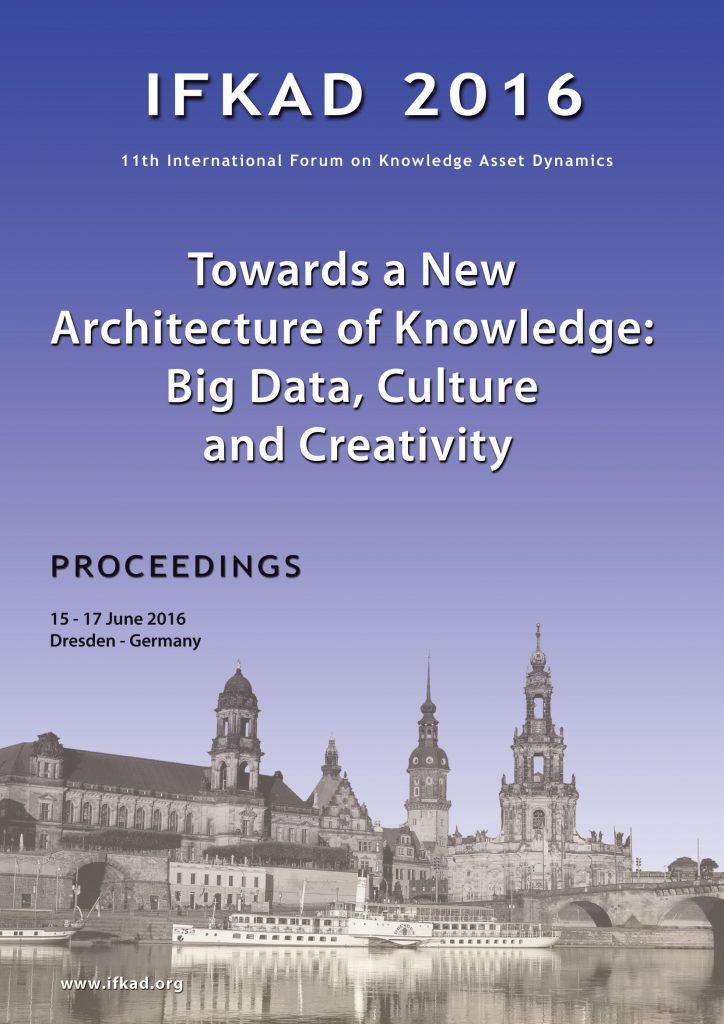
Proceedings IFKAD 2016

Towards a New Architecture of Knowledge: Big Data, Culture and Creativity
List of Included Articles:
Achieving the Future Strategic Competences Visible in Clay Workshop
Päivimaria Seppänen, Riitta Forsten-Astikainen

This paper offers a new approach to strategic management and the role of employees by defining a firm’s strategic goals for the future. In addition, it is useful to have individuals themselves define, interpret and recognize their potential skills and competencies using self- knowledge and reflection techniques. The new method also helps to include employees in firm strategy efforts. We propose an approach using an arts-based research method. The clay workshop is rarely used in scientific research discussions. This research examines the clay workshop methodologically. In strategic management when there is a need to find new outcomes, knowledge and competencies, the arts-based research method offers innovative and impressive space to find the new and make knowing and competences that haven’t been used in everyday life more visible. This methodology offers new evidence for strategic management research by concentrating on divergent knowing and competencies. The outcomes of this application demonstrate that the inclusion of employees in firm strategy efforts can be more diversity and greater creativity by increasing reflection as a method.

The relevance of organizational learning culture for performance: an empirical analysis on high-tech companies
Vincenzo Corvello, Piero Migliarese, Emanuela Scarmozzino

Although there is much emphasis on the importance of organizational learning culture and dynamic capability, little attention has been paid to their interactions and joint effects on performance. While the concept of dynamic capability has received increasing attention and numerous propositions have been suggested, few empirical studies have been conducted to examine its antecedents and outcomes. In this way, the paper aims to analyze how firms build dynamic capabilities, through organizational learning culture. We proposed an approach based on survey data, collected on a sample of high-tech companies. Organizational Learning Culture was analyzed as independent variables in terms of its effect of two different types of dependent variables (Dynamic Capability, Organizational Performance). Structural Equation Model was used to identify correlation between afore mentioned measures. This methodology puts in evidence that process management needs to be aligned with organizational contextual variables in order to build firms’ dynamic capabilities and consequently yield performance. Differently from much studies in this area (Hung et al., 2007), this study examine the mediating role of dynamic capabilities in the relationship between organizational learning culture and organizational performance, which contributes to make it particularly distinctive. Results of this paper highlight that organizational learning culture matters since it is strongly associated with variables influenced organizational dynamic capability and performance. Thus, when managers cultivate organizational learning culture in their organizations, should also consider to develop their dynamic capability in order to influence their organizational performance effectively.

National vs organizational culture
Kaja Prystupa

The organizational culture is indicated as one of the most important factors influencing knowledge management. In the literature there is ongoing debate about the link between national culture and organizational culture, especially in terms of a former being a constraint for the latter. The aim of this research was to investigate how organizational culture crosses the barriers to effective knowledge management. We propose the qualitative approach based on grounded theory and case study methods This methodology puts in evidence that the link between organizational culture and national culture might not be so strong. The founders my shape organizational culture in order to ensure effective knowledge management by implementation of norms and values typical for a particular industry segment. The other possibility lies in exposure to different national culture which is more conductive for effective knowledge management. The outcomes of the application this method bring important insight to managers in terms of sources of impact on organizational culture.

Corporate Learning 2.0 MOOC: An open online courses on formal and informal learning in organizations
Claudia Bremer, Joachim Niemeier

The paper describes an open online course which was run in 2015 under the title Corporate Learning 2.0. The course covered current developments, challenges, and trends in the field of corporate learning which evolve through the implementation of digital media. The course was designed in a way to support the collaborative and open generation of innovative ideas. The purpose of the study accompanying the course was to find out whether the target groups, mainly employees in companies in the field of corporate learning and human resource development, can be engaged in this type of online course and will exchange ideas openly in an online environment. The course was designed in a way that each week a new topic was introduced by the presentation of an actual and real challenge or problem in the field of corporate learning by one of the participating companies. Subsequently, the participants collected and exchanged ideas, got a deeper understanding of the problem and by doing so gained new insights into aspects of corporate learning. The design of the study included online questionnaires to access how participants evaluated the course, how they handled the technical platform which was used for communication processes and how they dealt with the openness of the course design. Additionally, tracking data was analysed as well as numbers of registration, badges, time for the completion of badges for each learning unit and so comparable data. The innovative aspect of the course lies in its approach to foster open innovation processes in the field of corporate learning, an area where this type of exchange has rarely been established yet (e.g. see Wallin and von Krogh, 2010; Chesbrough, 2006; Dahlander and Gann, 2010; Enkel and Gassmann, 2007). The course design is a prototype for an open online course in which a community of practice (Wenger, 1998) is used to exchange ideas and contribute solutions to real problems and challenges presented by companies. Therefore, the course served as an experiment to find out whether the target groups can be engaged in this kind of open exchange processes and whether it is possible to meet different interests such as personal learning for the individual learners as well as the generation of ideas for the participating companies.

Design Grafting as a Method for Cultural Cluster Development
Ahmet Can Özcan, Onur Mengi, Deniz Deniz

Unlike the conventional business clusters, the nature of cultural clusters is distinctive due to knowledge-intensity in production of culture which is transferable both from outside and inside of their spatiality. Earthenware pottery products crafted in Izmir, Turkey has recently declined due to the lack of new designs, promotion and marketing. This research intends to present a case study where the design grafting method has been implemented through a new knowledge acquired from an international joint venture experience and a great potential of intense know-how and knowledge gain through design, and branding strategies for cultural clusters. The design grafting process and its conceptual framework has been considered in the context of its possible role for cultural industry development. The international research project as a case study has been conducted in collaboration with foreign design institutions for design grafting implementation processes of Menemen pottery. The main objective is to transfer a foreigner design approach to current pottery making, and also manage the interdependencies between the acquired knowledge of unique design idea and its mass manufacturing in practice. The intention of such acquisitions depends integration of new design and production capabilities as maintaining cultural production process of pottery making. The employed methodology contributes to the previous collaborative efforts in knowledge creation, exchange, sharing and stimulate organizational change in cultural industry cluster. The research process improves our understanding of intra-culture design knowledge transfer processes, as well as the externally generated strategies in dealing with internal obstacles of cultural cluster. For such research, design grafting illustrates a unique collaborative effort constructed among different know-how located in different cultures. The grafting has been an actual implementation practice of design initiatives for producing, branding and identity reformation in pottery making as a cultural production. Sharing and brainstorming through collaborations within the research and design processes have been intended to transform the current craftsmanship into a more design-based and sustainable cultural industry. More significantly, this work has been a practical attempt that tries to integrate the grafting tool into the development strategies for a cultural industry concentrated in a certain location. This research can be furthered with the test of this proposed method in other cultural clusters and production sites.

Networks for Social Innovation: devoting “learning spaces” to social aims
Rossella Canestrino, Angelo Bonfanti, Pierpaolo Magliocca, Leila Oliaee

Our paper aims to investigate characteristics and the role that social networks have in the rising of SI. In doing this, we also examine the way social innovators devote to social aims, as well as how the set of relationships they establish may turn, over time, into locus for knowledge creation and diffusion, allowing the emergence of so-called Networks for Social Innovation (NfSI). We propose a two step-based approach. Firstly, an extensive literature review has been carried out in order to shape a more wide understanding of the SI, as well as to picture the characteristics and the dynamics of the NfSI. After this, a qualitative approach has been adopted by the means of ego-centred method for data collection. Three case studies located in the city of Naples have been selected and investigated in accordance with the chosen research technique. Our paper can contribute to the literature improving about SI by developing a more comprehensive knowledge-based and network oriented picture for SI. Our study allows academics and practitioners to recognize and understand SI, and how networks may be managed to support the effectiveness of firms’ innovative practices with reference to both business and social goals.

Developing knowledge through industrial archaeology: Evidence from Italy
Angelo Bonfanti, Rossella Canestrino, Pierpaolo Magliocca

This paper aims to highlight how the industrial archaeology may support the emergence of new spaces for knowledge transfer and development. We propose an inductive approach. The research strategy includes a multiple case study of Italian industrial companies that have invested in industrial archaeology since 2000. The choice of companies is based on a strategy of theoretical sampling. This methodology puts in evidence some Italian industrial companies that are investing in industrial archaeology to create value in a knowledge development perspective in the twenty-first century. The outcomes of the application outline how it is possible to turn old places – often degraded and abandoned – in “new” spaces for social meeting and cultural sharing by means of investments in industrial archaeology.

From individual to organization: the nesting architecture of T- shaped capacities in the knowledge economy
Mario Calabrese, Pierpaolo Magliocca, Cristina Simone

With the aim of deepening the study of the human and organizational cognitive endowment necessary to survive and innovate in a knowledge economy, in this study we theoretically explore and discuss the nesting architecture of ‘T-shaped’ capacities from individual to organizational level. The paper is rooted in the recent notion of ‘T-shaped’ knowledge and moves from the distinction between capacities and competences. A T-Shaped knowledge configuration means an endowment which includes both vertical competences (I-Shaped competences), but also ‘horizontal capacities’. We propose an innovative organizational design characterized by a nesting (“recursive”) architecture of T-shaped capacities. The “recursive” way to think of a T-shaped capacities set could lead to new way to frame and link together different dimensions of an organization: individual, structural and systemic. The emerging need for T-Shaped capacities set both at individual and organizational level is stimulating to deep understanding the basic elements of the T-shaped endowments. The “recursive” way to conceive a T-shaped capacities set could support organization in defining the cognitive richness and abundance (variety) necessary to effectively survive in environmental conditions of complexity. The principle of Ashby’s law of requisite variety is not an abstract concept. Rather it is a very concrete managerial principle: if an organization is not capable to change by adapting itself in response to external changes, it will not be able to survive.

Knowledge and Creativity and the Market for Entrepreneurs in ITC Industry
Hong Y. Park, Il-Hyung Cho, Sonia Park

For Whitehead (1978), creativity is about creative advance and creative imagination. Creative advance in Whitehed is the transformation of something into something better (Fetz , 1990). Creative imagination is about discovery of novelty and Whitehead uses the analogy of the flight of an airplane. Whitehead stresses the influence of imaginative thought in discovery of novelty. Lehrer (2012) argues that imagination reveals the deep inventiveness of the human mind and creativity is a catchall term for a variety of distinct thought processes. Therefore, we propose to develop an integrative model to unpack sources of creativity. Creative advance in business and economics is making products and services improve and introduce new products to markets. Knowledge and creativity afford ideas to entrepreneurs for new products. The entrepreneur has the power or energy to transform ideas in new products and services. The entrepreneur evaluates ideas stemming from creativity and knowledge and puts them into effect. The paper examines the market for entrepreneurs in ICT industry based on our theoretical framework. The purpose of our paper is to build an integrative theoretical model by connecting creativity from several disciplines. We believe that this is a unique approach and the study will shed new light on the complexity of creativity. Discovery of connectivity among philosophy, cognitive social psychology, sociology and sciences will enhance the understanding of creativity. The model may be very valuable to business leaders and policy makers in increasing satisfactions of consumers and citizens since the model help contribute to transforming firm’s product to better a product. Our study is to discover generalities of creativity by examining or observing extant theories and practices of creativity. Practitioners in businesses and governments apply these generalities to improve innovation processes and they become more creative.

Post-occupational study for TU-Dresden innovation sheds
Jörg Rainer Noennig, Michael Wicke, Sebastian Wiesenhütter

The purpose of this project report is to give evidence about the effectiveness of the provided service, and of the spatial appropriations of the iShed interiors as well as exteriors. A mixed method approach was taken that combines questionnaires, qualitative interviews, and ethnographic observation. The Project focused on the key factors given by the conceptual work of Lu (sense of belonging, Lu [3]) About the concept and idea of the Innovation Sheds has been reported already [2]. Focus of this article is not on highlighting the originality of the measure itself, but giving first evidence of their effectiveness. Upon the given data, the further development of TU Dresden Innovation Sheds will be decided. One future prospect is the potential extension of the iSheds into an informal open research village.

Cooperative Buildings and Creativity
Torsten Holmer

This paper describes the concept of Cooperative Buildings and how they are intended to support creative activities in organizations. Based on personal experience (the author was member of the team who coined the term) and a literare review of the citations of seminal papers we describe the history of this approach and show in which ways it was adopted. Future knowledge work is not about tools but environments. In order to optimize creativity, innovation and quality of work it is essential to design complex and flexible architectures that can adapt to different and changing needs. In order to avoid redundant research on collaborative buildings, a key desideratum is a critical reflection of past developments, and evaluation of existing approaches in order to inform related design activities mistakes in the future. Readers from technological disciplines get informed about scenarios, tools, platforms, service architectures and applications in the context of cooperative buildings. Major requirements and R&D directions in this area will be lined out. Architects and designers of knowledge work environments get informed about the state of the art of cooperative buildings, the success and failures and how to use this knowledge for their design activities. Researchers of knowledge work get valuable insights about trends in future work environments, methodologies and further research desiderata.

Innovating through contextual ambidexterity: Case study of health care firms in India
Ashish Malik, Rebecca Mitchell, Brendan Boyle

Literature on innovation management highlights the role of technological, human resource, and management practices in developing a firm’s innovative capacity. Further, organisations that are able to simultaneously develop learning processes of exploration and exploitation or in other words display ambidexterity, are more likely to develop long-term sustained competitive advantage through incremental and radical innovations. Yet, this line of enquiry is scarce in relation to developing countries such as India, especially for its health care sector. To this end, the purpose of this study is to uncover the key mechanisms and HRM practices that support innovation in the health care firms in India. Adopting an inductive case study approach, case analysis of two purposively selected health care firms in India was undertaken using Leximancer- 4, a specialist content analysis software for automated extraction of seed concepts. Our analysis focuses on two key aspects: (i) frequency counts and co-occurrence of text leading to identification of key concepts and themes; and (ii) depiction, through maps, of how these concepts are related to different seed concepts (Smith & Humphreys, 2006). This approach helps to reduce the researchers’ bias that is typically associated with manual coding and increases face validity, stability, reproducibility and functional and correlational validity. A guided analysis of the seed concepts and themes, its relationship with other sub-constructs and themes was undertaken using visual maps, textual exploration and frequency hierarchies relevant for this paper. This study represents a pioneering exploration of innovation in the context of India’s health care sector through intersecting literatures of ambidexterity, innovation and human resource and management practices. This study identifies the key mechanisms that support innovation and ambidexterity in health care firms. Managers can focus on allocating their resources in investing in these resources.

Closing the Innovation Gap: A Human Capital Perspective
Vidya S. Athota, Ashish Malik, Julia Connell

There is an increasing evidence that highlights the technical and cognitive strength of the Indian educational system and workplace training focusing on formal technical and cognitive skills. However, there is limited focus on developing non-cognitive skills, which is often purported as a critical set of skills relevant for supporting innovative forms of work organisation. The purpose of this conceptual paper is to highlight the importance of non-cognitive skills in supporting innovation outcomes in the context of a developing country such as India. This conceptual paper reviews the literature of individual level influences of cognitive and non-cognitive abilities and its relationship with innovation, especially in the context of a developing country such as India. This paper sets out to identify India’s innovation gap and how it might be addressed. It addresses why innovation is important particularly to India. This study works towards filling the gap of the micro-level foundations of individual values and personality traits of cognitive and non-cognitive abilities and its relationship with innovation. This paper aims to give insights from companies in emerging economies and explore the cognitive and non-cognitive knowledge gaps, as well as provide practical tools (in form of brief case study examples) to increase the non-cognitive knowledge base in organisations.

Knowledge Management of WOPping Water Operators: Case studies in Brazil and Uganda and Kenya
Silas Mvulirwenande, Uta Wehn, Christiana Metzker Netto, Mark W. Johnson, Adeline Uwamariya, Maria Pascual Sanz

Many water operators in developing countries have serious knowledge and capacity-related challenges that lead to poor service delivery. Water Operator Partnerships (WOPs) are used to strengthen the capacity of water operators for improved performance, by transferring knowledge from mentoring water operators to mentee water operators. Knowledge management (KM) within water operators requires urgent attention to ensure that the knowledge that is acquired in the context of WOPs is applied to help improve performance. The objective of this study is to investigate the KM processes of water operators and the factors influencing these processes. This study uses a qualitative case study approach, comparing three water operators involved in WOPs: two in Sub-Saharan Africa and one in South America. We use the Knowledge Value Chain by Weggeman (1997) to analyse the KM processes of these water operators. Data was collected using a variety of instruments, notably, via interviews, focus group discussions (FGDs), non-participant observation and desk research. We analysed the individual cases first, followed by a cross-case analysis. A large scale survey among US water supply operators showed that more than 50% of the operators are already implementing KM strategies. However, little is known about the extent to which and how water operators in developing countries implement KM; yet arguably they are most in need of sound KM practices to improve their service delivery. The insights into KM processes of “WOPping” utilities and the factors influencing these processes enable us to identify the most salient KM-related challenges faced by water operators and provide the basis for a structured approach to address these challenges. The analysis shows that in their efforts to implement KM, these water operators put emphasis only on selected KM processes. Organisational factors (e.g., structure, management style) appear to influence KM processes to a great extent. Moreover, the implementation of KM sometimes seems to be done in a haphazard way, partly due to a lack of clearly articulated knowledge vision and strategy. The successful implementation of KM by water operators appears to require (1) a multi-dimensional approach; i.e., focusing simultaneously on individual and organisational aspects of KM, (2) the use of both technological and non-technological approaches, and (3) a KM coordinating mechanism at organisational level. Most fundamentally, water operators need to appreciate the added value of KM and support it.

Effect of parental occupation and cultural values on entrepreneurial intention: A multicultural study across Spain and Italy and Germany
Iciar Pablo-Lerchundi, Gustavo Morales – Alonso, Hakan Karaosman

Entrepreneurship is often regarded as an opportunity for productivity increase and wealth generation, especially if the new firm is technology-based. Therefore, the research of factors that may determine young engineers’ positive attitude towards entrepreneurship is of great interest. The main purpose of this study is to verify the influence of close family and cultural values on the entrepreneurial intention of technical degrees’ students. Data from 1136 students in three different technical universities across Europe (Universidad Politécnica de Madrid, Politecnico di Bari and Technische Universität Berlin) were analysed. A survey explored their entrepreneurial intention and their perception of the support provided by their closer environment in case they decided to found a company. Other items explored the parents’ occupation (father and mother separately), as it is believed to be relevant for the success of entrepreneurial knowledge and attitude transfer from one generation to the next. Finally, cultural values based on Hofstede’s studies (1980; 1991) were also explored and their relation with entrepreneurship was analyzed. In Mediterranean cultures family ties are relatively strong, at least when compared with North European countries and North American societies (Reher, 1998). The traditionally existing family ties in collectivistic cultures may affect the mediating role model effect over entrepreneurial intention, while it may be the other way round in individualistic cultures. Therefore, in this research the influence of the family background on the entrepreneurial intention with the mediation of cultural values is addressed in three different countries: Spain, Italy and Germany. As the closer environment and the prevailing cultural values may foster (or hinder) entrepreneurial intention, it is relevant to know the extent of such influence. This is especially important for potential entrepreneurs in a technology-based field as the founding of technology-based companies is one of the best ways to increase productivity and wealth generation (Acs and Szerb, 2007). Therefore, technical universities play a key role on economic development as a technology transfer vehicle to society. For this reason, it is crucial to assess to what extent parents’ knowledge transfer can affect the entrepreneurial intention of technical degrees’ students.

Embrained Knowledge Defining the Boundaries of Small Firms
Biagio Ciao

Strategic paradigms include an assumption: growth ambition feeds a firm’s strategy. Without doubting the general validity of paradigms developed through the traditional economics and strategy approaches, this paper shows that those cognitions are the de facto developers of strategies and their analysis provides a complementary firm view, according to which some firms are not predisposed to increase their size. This paper inductively investigates the management’s cognitions of the Italian electronics firm Majestic. Majestic’s management aims to occupy declining segments that larger companies are no longer interested in. These segments do not require to grow and they allow Majestic to not face the competition of bigger and stronger players surviving with a small size. In addition, Majestic just need few resources and a limited innovation capacity to benefit from the declining markets which are not attractive for the bigger players but they are still profitable for small firms. The Majestic’s business vision can be a successful model for many small firms meeting difficulties to survive among bigger players.

Intellectual capital and knowledge management practices and firm performance
Henri Inkinen, Paavo Ritala, Mika Vanhala, Aino Kianto

This study aims at furthering this discussion by empirically examining on how the firm’s knowledge-base (i.e. intellectual capital) and the abilities to utilize and develop it (i.e. knowledge management) are associated with firm performance outcomes. In particular, the purpose is to examine firms with different profiles concerning their overall levels of IC and the KM practices, and whether there are differences between firms with those profiles in terms of innovation and market performance. Data for this study was collected via a survey from 259 Finnish firms with over 100 employees. Based on median split regarding the utilization of KM practices and the possession of overall IC, the firms were distributed into four profiles characterized with (1.) high IC and low KM practices, (2.) high IC and high KM practices, (3.) low IC and low KM practices, and (4.) low IC and high KM practices. Then, analysis of variance (ANOVA) was conducted to evaluate the statistical differences between the four different IC/KM profiles of firm to the innovation and market performance of the firm. Regarding innovation performance of the firm, this study finds that firms characterized with high amount of IC and high utilization of KM practices (profile 2.) are typically more innovative than the firms that possess low overall amount of IC (blocks 3. and 4.). Also, this study points out that the firms with high overall IC and low utilization of KM practices statistically beat the firms with low overall IC and low KM practices in terms of innovation performance. These finding indicate that both possession of sufficient levels of IC and the active utilization and development of it are required to increase the competitiveness of the firm. The extant literature on KM and IC have provided us with the basic understanding on how the knowledge resources and the practices or processes to manage them are associated with firm performance outcomes. However, our paper is among the first attempts to merge the IC and KM disciplines to find out which configurations could yield organizational benefits in terms of innovation and market performance outcomes. In sum, this study points out that while the level of IC alone could predict the innovation potential of the firm, the organizational and managerial practices to leverage the IC are needed to transform the knowledge potential into market performance. This results is interesting for knowledge and innovation management research and practice, since it shows the merits of letting innovation flourish also without a high level of managerial control, while pinpointing the increasing relevance of knowledge management when actual market performance is in question.

Virtual Global Teams as Value Creating Tools for Knowledge Sharing and Innovation
Johan Olaisen, Oivind Revang

The purpose of this study is to explore how to facilitate for the sharing of high quality knowledge in a virtual global project team context. Consequently, this study presents an overview over selected theories, and enlightened by these theories investigates how the strength of social interaction ties between members in a virtual team affects the quality of work related knowledge shared in these ties. Social interaction ties are represented by strength of the relationships, the amount of time spent on interaction, interpersonal trust and communication frequency between the members in a virtual team. Whereas knowledge quality is defined as the extent to which the comprehension and awareness of relationships, logics and innovative ideas in a project are valuable and relevant. Based on case studies of 4 virtual global project teams with a total of 41 team members We found that competence-based trust ties was the component that had the greatest impact on this high quality knowledge sharing. Frequency of communication ties and time spent on interaction ties were found to have a positive effect and benevolence-based trust ties have some effect on the knowledge shared. Close relationship ties on the other hand are shown to only have a very small noticeable impact on the quality of knowledge shared between team members in a virtual team and the closeness of social interaction ties between members in a virtual global team does not affect the quality of knowledge shared. Virtual interaction in virtual global project teams does not require physical interaction to work, which is a significant finding not only for academia but also for any project manager. The empirical evidence shows support for the notion that the strength of the competence based interaction ties between members in a virtual team positively affects the quality of knowledge shared in these ties. The evidence also support that the quality of the virtual networking is affected by sharing the work process from concept development through all mile stone gates to the delivery. On line competence based relationships do not require off line competence based relationships to work. This means that a technology-based platform might give the social relationships needed for knowledge sharing.

Continuous Knowledge Transfer – a pragmatic approach to knowledge sharing in the European Patent Office
Hanno Schombacher, Philippe Lahorte, Lars Vistisen, Anton Versluis, Fernando Correia Martins, Wolfram Meyer, Paula Patras, Xavier Bardella, Florence Roux, Angela Kreuter, Jan Hellberg, Jeremy Scott

The European Patent Office (EPO) is one of the main players in the world of patents. Patent examiners are highly skilled knowledge workers who deal with explicit and tacit knowledge. The identification of tacit knowledge sources and the creation of knowledge through tacit to tacit knowledge sharing and tacit to explicit knowledge sharing are fundamental to the success of an organization [1]. This is in particular valid for an organization like the EPO. The development of a practical approach to share tacit knowledge in the EPO, is presented aiming at sharing experience with similar players and enhancing discussions on the practical implementation and implications of such processes in a highly efficient environment. Starting from locally driven initiatives, the European Patent Office during the last 15 years has established an internal peer to peer knowledge sharing process. This process is driven by a team of knowledge sharing experts, collated in a team called CKT – Continuous Knowledge Transfer. The process works in a complementary manner to classical and well-elaborated learning and development activities of the international organization. The success of the process is demonstrated by user statistics. Patent Examiners have to deal with a complex set of information-based procedures and associated supporting tools, all of which are continuously and rapidly evolving. Thus, patent examiners can be seen as knowledge workers par excellence, who on “non-routine” have to solve problems that require a combination of convergent, divergent and creative thinking. As a consequence as service professionals and knowledge workers patent examiners have a strong interest in effectively and efficiently managing a wide variety of knowledge sources and inputs. The knowledge sharing process established at the EPO has developed over the last 15 years to a mature state. The process is accepted by staff and management at the same time and contribution to success of the organization is significant. The EPO has a core competence in the management of technical knowledge per se contained in patent databases as well as scientific or technical prior art databases. In total these databases are closing in on one billion records. Via its CKT initiative, the EPO has developed knowledge transfer processes and corresponding IT infrastructure, going beyond this core competence. The contribution aims at presenting and critically discussing the services developed by CKT.

Human – architecture – technology – interaction for demographic sustainability
Elisa Rudolph, Gerrie KleinJan, Stefanie Kreiser

A prerequisite for the development of architecture’s potential to support a safe and independent living of all people is the planning of demographically sustainable buildings. This includes age-appropriate, mainly barrier-free architecture, and the use of ambient assisted living systems. In practice, however, there are currently great obstacles realising buildings for the older generation. Essential starting points for overcoming these difficulties are the improvement of the education and further training of architects, as well as the hitherto often insufficient interdisciplinary exchange in the planning process between architects, technical planners and the housing industry. As a first step the education, further training and existing knowledge of architects were analysed. This included a research of the education content of architecture students at the nine leading Institutes of Technology in Germany (TU9), an online survey for architects to assess their knowledge of building for older adults and disabled people, as well as an analysis of further training courses for barrier-free planning offered by the Architectural Associations of the federal states in Germany in the past three years. As a second step the cooperation between architects and technical planners was investigated. In addition, their interaction has been studied in four best practice examples. The design of barrier-free architecture is often underrepresented in the education at the TU9 and accessibility seems to be an unattractive topic there. In summary, it can be stated that accessibility and design of demographically sustainable buildings should be an obvious part of architectural education. In addition, it is useful to offer additional training courses for architects that fill in the gaps in their education, improve their knowledge, discuss the accessibility of buildings and ambient assisted living systems and also deal with current, aesthetic and practical design solutions. The interviews, which were part of the second step of the research, form the basis of an in-depth and comparative analysis to cooperation and existing challenges in the planning process. The analysis showed differences in type of client, project organisation, user requirements and applied ambient assisted living systems, while the projects had parallels in the cooperation of the planning partners. Finally, success factors were identified for cooperation and planning in future demographic sustainable projects. Keywords – ambient assisted living, accessibility, education, process management, planning

Proceedings IFKAD 2016
Towards a New Architecture of Knowledge: Big Data, Culture and Creativity

Submit the following information to receive the download link 

a valid email address where the download link will be delivered