PROCEEDINGS e-books

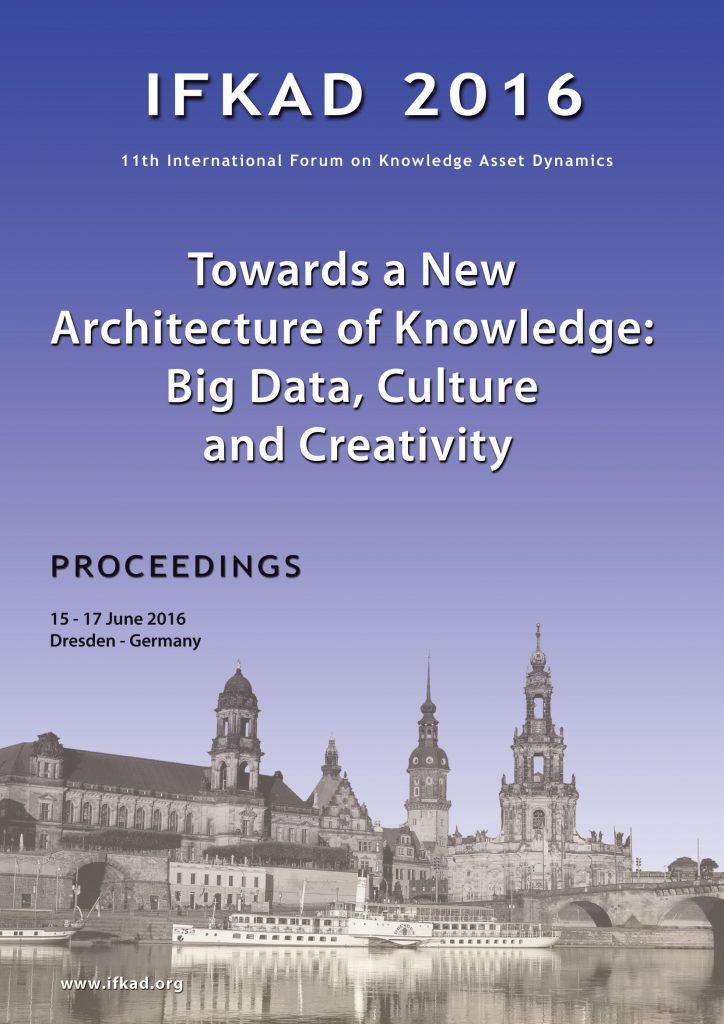
Proceedings IFKAD 2016

Towards a New Architecture of Knowledge: Big Data, Culture and Creativity
List of Included Articles:
Graphing Meeting Records – An Approach to Visualize Information in a Multi Meeting Context
Bettina Kirchner, Jan Wojdziak, Mirko Almeida Madeira Clemente, Rainer Groh

Meeting notes are effective records for participants and a source of information for members who were unable to attend. They act as a reference point to decisions made, to plan next steps, and to identify and track action items. Despite the need for a multi meeting solution (Tucker and Whittaker, 05), meetings are often displayed as separated as well as descriptive documents. The aim of this work is to enhance access to overlapping meeting contents and existing coherences beyond a decoupled description. A visual representation of meeting content can lead to meeting records which are more comprehensible and more time efficient. Furthermore, it enables the depiction of knowledge that is often lost in conventional meeting records. Our goal was to define a general structure for meeting items, integrating content categories and relations between successive meetings. In this paper, we present a model based approach to visualize meeting content as well as content relations in order to support the preparation, execution and follow-up of meetings. Due to the fact that contents of consecutive meetings refer to each other (Post et al., 04), we consider meetings as a series of events. The resulting model substantiates the transformation of content as well as content relations into a visual form. The proposed solution focuses on the model that is integrated into an interactive visualization. Thus, a novel approach to explore meeting records is provided. The model was proved to be suitable for meeting contents in various use cases. Examining the content in its visual representation across multiple consecutive meetings enhances the identification of any linked information at a glance over even long periods of time. Hence, important pieces of information will not be disregarded. The approach of our multi meeting protocol application is realized as a browser-based implementation that displays data from JSON objects. With this interactive visualization, the user can browse, search, and filter meeting content and get a deeper understanding of topics, their life cycle and relations to other topics. This leads to an overall comprehension of project or business progression that highlights topics that need to be addressed. Thus, the viewer is supported in preparing, executing, and following up meetings successfully and qualified to structure records in order to keep a clean transcript of a meeting.

Visual media as tool to acquire soft skills – interdisciplinary teaching-learning project SUFUvet
Patric Maurer, Antonia Christine Raida, Ernst Lücker, Sander Münster

SUFUvet is a cross-disciplinary teaching-learning project designed to adapt students’ soft skills and track usability and the concrete surplus value of work techniques in the field of visual media design. For SUFUvet, a collaboration between the Institute of Food Hygiene/University of Leipzig and the Media Center/Technische Universität Dresden was initiated. Bachelor students of media informatics generate 3D visualisations in the framework of SCRUM: Undergraduate veterinary students issue instructions in order to create an e-learning class. During the project, questionnaires, group discussions, and feedback methods are used to detect changes in selected soft skills. This design is meant to increase knowledge and employability by adapting student’s media, communication, and project management competences. Using SCRUM appears to be a new approach, not only in the field of programming, but for media production as well. Additionally, it offers an interdisciplinary work environment, which is rare but considered fruitful within university studies. The outcomes of the application are a 3D-visualised meat inspection e-learning class for veterinary students plus a documentation of SCRUM as a framework for visual media design. It is seen as an experiment for future applications in a variety of cross-disciplinary learning and media design cases.

Constructing organizational realities: Interaction and meaning making and liminality in personnel training
Riikka Nissi, Jukka-Pekka Heikkilä

In recent years, liminality has become one of the key concepts in delineating the features of contemporary working life. In organizations, it has been particularly connected with an episodic process, where the organization is led to a self-reflexive state in order to provide a space for the participants to create a renewed understanding of the organization and its culture. However, prior research has paid little attention to the way such liminal states may be constructed in actual organizational life. In this study, we will approach liminality as a distinctive interactional space and investigate how it is accomplished as a concerted activity of the participants. By focusing on the micro-level organization of the participants’ social conduct, we aim to demonstrate the complex changes taking place in interaction and the way they are used to create a space for shared self-reflection and knowledge construction the liminal state is set up to evoke and advance. Our data originate from a personnel training of a public, knowledge intensive organization. The training events were attended by 60-250 staff members, the management of the organization and one or more consultants from the company the training was purchased from. The events were videotaped for the purposes of this study, leading to approximately 30 hours of data. This data was then analyzed by applying multimodal interaction analysis. In our analysis, we will investigate the sequential unfolding of the training event, focusing on three specific phases in its overall structure: 1) the opening talk of the consultant, 2) the construction of narratives through group work and 3) the joint closing discussion. Our focus is on the interactional and discursive construction of these phases and the way they contribute to the creation of the training as an interactional activity type. By doing so, we will demonstrate how the liminal state of the training commences from the interplay between different phases of the event. The study will bring a new understanding of the interactional accomplishment of liminality as a transformational space for shared knowledge construction and organizational learning. Moreover, it will provide opportunities for professional reflection in terms of how to best utilize such interactional spaces for different organizational activities. In conclusion, we will discuss these views and reflect how the results of the study could be applied in the professional practice of consultation concerned with knowledge work.

Zines as qualitative forms of analysis
Monica Biagioli, Allan Owens, Anne Pässilä

This report brings forward the possibility of capturing creativity and human experience through a visual ethnography approach, applying the use of ‘zines’ as a means of capturing individual engagement with a process. Zines are small (maga)zines from the do-it-yourself movement. They began as a means for fans to express their support of favourite musicians. They are a means to express collective voice from the ground up, less formal than a publication produced by an entity, but formal enough to be considered publications in their own right. Zines can be handcrafted in rough method or can be beautifully designed and produced to very high standards. Zines are presented in this paper as a method of collecting and analysing data within a framework of qualitative analysis that retains more of the shape of the complete experience (Dewey). This is done so as to maintain a more overall sense of what the experience was for an individual participating in an activity within the organisational context. Accounting for experience only through evidence, this paper argues, loses many important elements of experience, such as tacit engagement, experiential knowledge, and individual judgement. What is being lost, this paper argues, is the human creative input and engagement with experiences in the organisational and workplace context. For IFKAD 2016, we propose to produce materials ahead of the conference (in the form of an advanced colouring book or a photo album) and invite participants to gather materials, notate impressions, draw and photograph in response to their experience in the conference. We aim for this zine to be a holistic record of a process, incorporating both positive and negative elements as a way of informing future activities. At the end of the conference, the researchers will collect and analyse the individual zines submitted by the conference participants and prepare an edited summarised publication of key impressions as made by the participants themselves as a response to the conference. This work proposed could be done solely for the Creative Coordination track or could involve all members attending the conference. The aim is is to implement this as a qualitative means of accounting for human experience by using IFKAD 2016 as a testing ground. Can we capture the thinking and impressions in this way to account for creativity and inform new methods? The researchers will co-create the materials to go into the. At the end of the conference, we will gather all mini publications from all the conference attendees who took part and create an edited summarised publication as a response to the conference. This will constitute a qualitative record of the creative endeavour during the conference.

Arts in the Military – A theatrical Performance Exercise
Susana Vasconcelos Tavares, Anne Pässilä, Allan Owens, Filipa Pereira

Our aim is to explore to what extent, and in what ways, can theatre be used in the learning process when the focus is on deepening the leadership skills of managers. This paper focuses on the concept of arts-based initiatives (ABI) as knowledge co-creation in a group of practitioners. The unit of analysis is a theatrical performance exercise (TPE) at a Marines’ Military Academy. Through observational and interview data gathered at this Academy, a case study approach is used to explore the experiences of participants in a performance exercise, where the task is to plan, organize and execute the play as a group. This includes, scripts, characters, role-plays, costumes, stage decoration, sound, promotion and performance of the theatre play. We situate theatre as knowledge co-creation within ABIs framework, review related literature and then analyse the experiences of military students throughout the process of creating and performing the theatre play. Finally, we present key findings about the kinds of value that the military students identified in the theatrical experience. In the end, we conclude as to how theatre can be used in the learning process, when the focus is placed on deepening leadership skills of managers, and identify the benefits that can emerge from it. There is a growing cry for ways of approaching management and leadership development that embrace the perplexed environments of contemporary organisational contexts. One response has been the use of arts-based initiatives (ABIs) for management and leadership education. Schiuma’s (2011) study suggests arts-based working has effects both on people and on organizational infrastructure with varying effects and intensities. In this study we are interested in exploring what possible benefits could emerge from ABI. Namely, understanding theatre in military training as a value driver to develop leadership skills and to organizing reflection via arts-based approaches (Pässilä & Vince, 2015) and critical creativity concerned with understanding (Adams and Owens, 2015), This paper speaks to knowledge management researchers, professionals, and development practitioners, the study overviews the growing trend of ABIs and its possible benefits, highlighting reflection on and of emotions, thoughts and challenges.

Does Interaction between Intellectual Capital Elements Influence Performance of Russian Companies?
Tatiana,reeva, Tatiana Garanina

Intellectual Capital (IC) has been argued to be the key element of value creation in contemporary economies, and this argument has been widely supported by empirical research, based on data from developed markets. Yet, despite strong interest in the topic and growing body of research focused on it, neither academics nor practitioners have come to one single conclusion concerning which elements of intellectual capital – human, relational or organizational – play a more important role in value creation of a company and how they influence different aspects of organizational performance. It also remains unclear whether it is important for a firm to have all elements of intellectual capital – human, relational and structural capital – well-developed, or managers can focus just only on one or two of them, if they have limited resources. These questions are particularly burning for emerging markets’ firms. Does IC matter much in this context? Based on previous research one can also question whether IC matters at all, and, more importantly, whether investing in all elements of intellectual capital would not be too heavy a burden for a company that would deteriorate its’ performance. This study aims to explore this question by analyzing the joint effects of human, relational and organizational capital on organizational performance in an emerging Russian market. The data for the research was collected in January-March 2015. The sample comprises 240 Russian companies. The findings of the paper suggest that having several elements of intellectual capital well-developed simultaneously does not bring additional value in enhancing organizational performance of Russian companies. Therefore, managers can focus on developing only those elements of intellectual capital that matter most – that is structural capital, according to our findings. This brings us to the conclusion of the specifics of the Russian market. The findings contribute to further development of IC theory by providing a more fine-grained understanding of how different elements interact in the particular emerging economy context. The core managerial implication of this study is that building structural capital, providing employees with efficient and relevant information systems and tools to support cooperation between employees, as well as carefully documenting organizational knowledge and making it easily accessible for employees, should be a management focus for manufacturing companies.

Intellectual capital and product novelty: empirical evidence from Russia
Carlos Jardon, Mariia Molodchik, Daria Skidnova

The paper explores the relationship between different types of intellectual capital and product innovation of a company. The study uses resource-based view as a theoretical framework. Drawing on literature review the authors put forward the hypotheses about the positive influence of human, structural and relational capital on the probability of transition to higher level of product novelty. Using the dataset for more than 1600 Russian small and medium size companies from manufacturing industry and implementing logistic regression analysis the authors test the hypotheses put forward. The results established in this study confirm the hypothesis of positive relationship between endowment of intellectual capital and the novelty level of a product introduced by a company. The study also extends empirical knowledge on innovation performance and intellectual capital employment in the context of Russian business environment.

The Intellectual Capital and its Relationship with the Competitiveness: A Study in Higher Education of Mexico
Antonio Jesús Vizcaíno, José Sánchez Gutiérrez, Juan Antonio Vargas Barraza, Elsa Georgina González Uribe

It has been conferred on the Higher Education Institutions (HEI), knowledge transfer, training and development of scientific research, but it is thanks to the intellectual capital that universities achieve their corporate goals, to allow quantification and measurement intangible assets such as human, relational and structural capital to manage their resources. Proper management of intellectual capital enables a further increase in the competitiveness of higher institution. This research focused on identifying the relationship between intellectual capital and competitiveness variables in four universities in Mexico The base of intellectual capital (IC) is knowledge, intangible resource and major source of innovation in creating value for organizations and competitiveness (Diaz, 2012), it is considered a resource of knowledge that organizations use to generate a lead competitive (Kwantes, 2007). The quantitative study was cut, descriptive, explanatory and correlational in which the relationship between intellectual capital and competitiveness, implemented in IES of Mexico is established through a survey of 120 academics who collaborated on the study. The questionnaire was designed with 73 closed questions using Likert scale to inquire about the intellectual capital and the factors influencing competitiveness as IES, obtaining a Cronbach alpha reliability of .858. Frequencies were obtained by sphericity test for the characterization of teachers and factor analysis was applied to the correlation of variables finally performing the ANOVA for hypothesis testing. The methodology to analyze the correlation between intellectual capital and competitiveness variable, HEI where the study was applied. The results of the study show that planning, leadership, measurement, technology, vision and strategy, decision making, learning and knowledge in higher education institutions influencing competitiveness and create an opportunity to develop intellectual capital and increase their quality.

Dynamic Organizational Development – The Role of Data and Information and Knowledge
Øivind Revang, Johan Olaisen

This study investigates how the organization of and access to different sources of data, information and knowledge create absorptive capacity that contributes to first/prime mover competitive advantages. It is an explorative single case study (Eisenhardt & Graebner, 2007,29) of a shipping firm delivering services to the offshore oil industry. The study has an ethnographical flavor in that we where ‘part of the organization’ in formal and informal settings in intensive periods over a long time span. The interaction was limited to a group of the top twenty managers at the company headquarter. We use a phenomen-oriented approach (Alvesson and Kärreman 2007; von Krogh et al., 2012; Schwartz and Stensaker, 2014, Doh, 2015) that starts with an empirical phenomenon and uses different streams of theories to establish understanding of the phenomenon. While many studies of how firms use data and information to make grounded decisions few studies have been conducted at a micro-level focusing on the organization and interaction between information and knowledge from different sources. The study shows how analytical tools based on “big data” functions as input to a process where social knowledge provides the context that create meaning to these data. The study is original in providing insights concerning knowledge, skills and data necessary for exercising management and leadership to establish absorptive capacity to sustain as a prime mover advantage. The phenomenon studied is foundation processes for creating absorptive capacity. There are several outcomes of this phenomenon-oriented study. It is practical because it identifies and analyses real world firm challenges and point to practical solutions that not necessary can be deduced from theory. While most studies of knowledge and absorptive capacity are done at a macro level, with intentions to find significant relations between variables across organizational units, this study identifies organizational mechanisms in use at the micro-level to achieve absorptive capacity. Which in turn represent challenges for managers both to contextualize and implement in other business settings. It is also theoretical important because it frames practical behavior that cut across different streams of knowledge creation as theoretical conversations concerning dynamic capabilities, organizational learning, strategy and knowledge management.

Beneath the surface: Exploring the role of individuals learning in the emergence of absorptive capacity
Karl Joachim Breunig, Ieva Martinkenaite

Drawing on the micro-foundations view of strategy, we examine the role of individuals in organizational learning and reveal the micro-macro interactions underpinning the emergence of a firm-level absorptive capacity. Whereas most of the absorptive capacity research focuses on interaction of external and internal environments, we emphasise the interplay between organizational and individual levels of absorptive capacity. We find that the nature of knowledge, the role of individuals and their social interactions are explicitly addressed in the seminal works of Cohen and Levinthal. However, these micro-level considerations are insufficiently problematized in subsequent research. This neglect has resulted in limited explanations of how absorptive capacity emerges as an organizational-level phenomenon. In this study, we employ a longitudinal case study design to explore the role of individual learning in the emergence of a firm-level absorptive capacity. We selected one multinational, knowledge intensive firm as our research setting. Data has been collected over a ten-year period. The focal firm operates in a mature industry, experiences technological disruptions and global pressure to innovate, and, hence, provides opportunity to explore how absorptive capacity emerges over time as a consequence of individual’s learning. Based on a longitudinal case study, we re-conceptualize absorptive capacity as a set of three, sequentially inter-linked learning processes in which individual and organization interact and suggest three propositions for further empirical research. We show how absorptive capacity emerges into an organizational learning capability that involves the micro-level knowledge processes that underpin absorptive capacity of an organization. Our findings reveal how tacit, situated, and distributed organizational knowledge affects the development of absorptive capacity as an organizational learning capability. This is achieved by distinguishing between individual- and organizational-level attributes of absorptive capacity, and through examining their dynamic interactions within each phase of absorptive capacity process—i.e., the recognition of value, the assimilation, and the application of new external knowledge to commercial ends.

Managing knowledge in tourism destination networks: the potential of theoretical diversity
Valter Cantino, Damiano Cortese, Francesca Ricciardi

This study highlights the huge diversity of the possible theoretical views of the role of knowledge in tourism destination networks. For this purpose, this paper provides a synoptic comparison of the relevant explanations and predictions that can be deduced from six important theoretical views, including both well-established, mainstream organizational theories and emerging inter-disciplinary approaches. The six theoretical clusters considered for this study are investigated through a comparative analysis of the literature. The results are synthesized in a prediction matrix. The results of this study show that the six theories differ significantly as for the expected benefits and success factors of knowledge management and organizational learning in tourism destination networks. Overall, the six-theory matrix offers a rich and complex framework with a strong explanatory potential, which calls for the setting-up of clear criteria of meta-theoretical brokering and integration. In the final part of the paper, the authors discuss the managerial implications of the six-theory prediction matrix. In particular, the authors highlight the possible usefulness of the pluralism of possible management criteria implied by the prediction matrix.

Formula 3C: “Creativity – Creative Knowledge – Communication”
Arūnas Augustinaitis

The purpose of this article is to deliver an analysis of the communicational nature of creative knowledge, by forging a link to the informational logic of the post-modern society. Creative knowledge is perceived as an attribute of an information world, which explains the growing penetration of creativity into contemporary social (and economic in particular) relationships. Creative knowledge is considered an integrated element of the architecture of knowledge, which is expressed through different forms and processes of communication. The ways in which communicational mechanisms structure and handle creative knowledge are analysed. A concept is brought forward that is based on the objectification of creativity with the help of communicational tools of creative knowledge. The underlying assumption here is the influence of communicational expressions of creative knowledge, which explains the increasing penetration of modern creativity into social and economic relations, by actualising the communicational approach. The proposed conception is broader interpretation of 3T presumptions model (Technology, Talent, Tolerance) by R. Florida from the communication perspective, which involves an analysis of the 3C (Creativity, Creative Knowledge, Communication) triangle. The key structural logical aspects of the report are as follows, Creativity paradigms and assumptions for its substantiation and objectification Evaluation (measurement) of creativity Methodological basics of the concept of creative knowledge Communicational organisation of creativity This methodology puts in evidence the fact that creativity can be organised and managed through application of communicational tools to structures of creative knowledge. The article methodologically formulates presumptions for substantialising and managing creativity. According to the 3C concept that has been developed, creativity is grounded on creative knowledge and communication mechanisms. At the same time, criteria for the evaluation and effectiveness of creativity are being formulated. Equally important are studies of the media and procedural expressions of creative knowledge, which are summarised as communicational criteria of effectiveness, discussing their applications and possibilities. From the practical point of view, creative knowledge communication boosts the outcomes of creativity and the potential for managing creative processes. The essential relationship between creativity and the modern society is expressed through the integration of creative processes into value-generating chains and models, as well as into the new structures of the global factors of competitiveness. It is suggested that creativity is an assumption of the existence of the post-modern society and competitive relations, which requires strengthening the economic and social effectiveness of creative activities.

Theatre in Prison as a Virtual Place of Knowledge Creation
Gabriella Piscopo, Giuseppe Festa, Rocco Palumbo, Gabriella Ambrosino

Through the “Gozzini” Law, the Italian penitentiary system identifies inmates’ re-education as the main aim of personal detention; theatrical performances are included among the treatments which are intended at promoting the inmates’ social reintegration. Prison theatre allows the establishment of a performing space, which paves the way for the activation of innovative learning processes. Drawing from the knowledge creation theory, this study is aimed at examining the prison theatre phenomenon, which is eventually conceived as “Ba”, a physical, virtual, and symbolic space where the mutual interactions between different agents fosters the creation of cathartic and transformative knowledge. Drawing from the “double loop learning” perspective, an in-depth exploratory case-study was performed. It concerned the prison theatre initiatives launched by the Penal Institution of Naples-Secondigliano, in the South of Italy. A qualitative approach is adopted, which allowed to deal with the main issues of analysis from both a conceptual and an empirical standpoint. To improve the reliability of this study, the evidence collected were drawn from multiple sources, 1) internal archives of the Italian Ministry of Justice; 2) semi-structured interviews; and 3) external sources. The triangulation of evidence collected allowed to achieve a stronger consistency of the findings discussed. The relevance of this study is twofold, contributing in both conceptual (observation) and theoretical terms (abstraction) to a widely overlooked shade of knowledge creation, appropriation and sharing. To the knowledge of the authors, penal institutions are still poorly examined by scholars interested in public management, in spite of their role in enhancing both social and economic development in current societies. The case-study discussed provides an in-depth exploratory analysis of prison theatre, adopting the phenomenological perspective of “Ba”. The findings of the research point out the key tools to make prison theatre a physic and symbolic place, where inmates are able to build knowledge and can “reborn” through the process of knowledge sharing. This study paves the way for two important contributions, 1) it encourages a cross-fertilization between managerial science and juridical, sociological and pedagogical disciplines, which are relatively more rooted in the penitentiary environment; 2) it incites an improvement of traditional managerial and organizational practices in the penitentiary system.

New Technologies for Social and Learning Museums
Mauro Romanelli

The study aims at explaining how Internet and interactive technologies are driving museums as institutions information-based, knowledge and learning oriented to reconcile both traditional authority and increasing participation of audience on cultural heritage by structuring virtual museums as environments for learning by enhancing educational mission and purposes. Museums seeking legitimacy by embracing new technologies contribute to generate social value and promote social innovation managing cultural heritage coherently with new trends of participation in cultural activities based on information, communication and knowledge sharing by designing virtual environments for involving audience to take part in the cultural production. This study is based on archival and qualitative data drawn by literature review about the use of the internet technologies of information and communication within museums. New technologies are leading museums as organizations audience-driven to reinvent the educational mission and behave as hybrid organizations managing different and competing logics to combine traditional authority on definition of cultural meaning of artefacts with opening up to active participation of users by encouraging new cultural and learning experiences beyond the virtual museum moving from preserving collection to managing information towards a participatory and knowledge oriented museum. Museums managing information and knowledge through museum professionals dealing with new technologies enforce the logics authority that benefits of increased participation becoming centres and spaces of social innovation for knowledge sharing and learning development.

Creative learning spaces and practicing theory and theorizing practice
Alena Siarheyeva, Guillaume Perocheau

The article presents a case study of pedagogical experimentation of teaching for creativity in a French high engineering school offering training in electronics and computer science. The experimental project encompasses i) new instructional design – specific, systematic methods and tools deliberately supporting creativity and ii) new learning environments – physical space configurations, material objects, artefacts and digital tools. The experimentation is rooted in the socio-material perspective in human geography and sociology that highlights that physical space interacts and interrelates with the social world ( (Massey, 2005), (Lefebvre, 1991) and (Soja, 1989)). It attempts to contribute to emerging field in educational research linking learning environments and training for creativity (Tsai et al., 2015; Studente et al., 2015; Tekic et al., 2015). The early findings of the research suggest that relationship between space and learning for creativity seem not to be straightforward or linear, or at least, cannot be measured with currently available tools and methods. Instead, teachers and learners go through phases of discovery, experimentation and co-construction of new codes of behaviour, practices and attitudes in the new physical space. They create a new social space for interactions afforded by physical space and boundary objects. At organizational level, these processes may impact organizational practices, routines and codes of conduct.

Digital-craft: how a startup creates innovation by combining traditional craft skills and technological capabilities
Francesco Bolici, Nello Augusto Colella

This article studies organizational innovation as result of the combination of different skills, mindsets, competencies, perspectives and experiences. The purpose of this article is, i. to identify an empirical case where different knowledge-domains interact, enabling the emergence of organizational innovation. Our specific research focus is the overlapping area between traditional artisanal work and innovative technological solutions; ii. to analyze the genesis, evolution and characteristics of this empirical case, underlying both its advantages and flaws; iii. to provide insights about how handicraft and digital technologies -often characterized by extremely different mind-sets, tools and strategies- could be linked for mutual and reciprocal benefit. We chose to follow a qualitative case study methodology to “identify how a complex set of circumstances come together to produce a particular manifestation” (Hancock, et al. 1998 p.7). Thus, we attempted to capture as many variables as possible through unstructured interviews with the company founders and through documents and reports we were able to collect from the organization itself. The case study methodology, with its inductive approach, has also been chosen to support the development of concepts and theoretical models useful to understand the social dynamics emerging between two different cognitive domains (handicraft and digital technologies). The field of innovation in organizations is broad and well studied. Building on existing literature, we focus on a very narrow and relatively under-investigated research area, the possibility to combine traditional craft skills with modern digital technologies to reach the competitive advantage. The attempt is to define and discuss concepts and variables that, emerging from the case study, could contribute to shape a theoretical model to be fully developed and tested through future research. Besides the theoretical contribution, the paper attempts to identify and to discuss a set of insights potentially useful for those organizations, operating in the handicraft or in the digital technology sector, that are looking for opportunities to expand their strategic options. The structured analysis of the advantages and disadvantages of combining a traditional handicraft organization with a technological one could represent the opportunity to learn from existing empirical evidences without mechanically follow the same patterns.

New Dutch Makers: (Social) empowerment through making
Youri Havenaar, Ingrid Mulder, Han Meer

The current article reports the New Dutch Makers-project (Havenaar, 2016). The Library The Hague communicated the wish of the integration of a technological laboratory inside the Library Schilderswijk, which has been completed during the process of the project. We propose an approach of multiple project phases in order to tackle the projects complexity. Each phase has a goal and a different approach to reach this goal. After the four main phases are completed a final evaluation phase cross-checks the goals that have been set at the beginning of the project and assesses whether these goals are met. The project has a research-through-design approach with which the local youth is involved throughout the entire design process in order to create a best as possible fit with the technological laboratory. This methodology puts in evidence that integrating a technological laboratory inside a library provides the local youngsters with a place near-by to learn with, and from, others. The threshold to participate is low since the involvement of the target group throughout the process is high. Not only do the participant learn technological skills with the different machines and techniques which are provided, but the youngsters have developed themselves on social areas as well.

The practice of managing a knowledge-intensive organization – the role of knowledge management
Antti Lönnqvist

To better understand the added value that knowledge management as a managerial approach can bring to the management of knowledge-intensive organizations. This paper explores empirically the actual management practices of a knowledge-intensive organization and examines how knowledge-related phenomena are managed as embedded aspects of management. This paper makes a contribution to prior discussions concerning the relevance of knowledge management and the role of knowledge management as an embedded management practice. The findings of this study should be useful in explaining practitioners the nature, relevance and value of knowledge management.

Intensity of use of knowledge management systems in supply firms: a methodological approach and empirical analysis
Piera Centobelli, Roberto Cerchione, Emilio Esposito

This paper provides a taxonomy of knowledge management systems (KMSs) in small supply firms and identifies relevant tools and practices supporting firms in the different phases of knowledge management process. Based on a field analysis that involved 61 small suppliers operating in high-tech industries, the paper highlights that suppliers are generally inclined to use not updated KMSs instead of the newer ones, which are also cheaper and user friendly. This gap shows the difficulties that small suppliers have to be responsive to the rapid technological changes. The field analysis also points out that small suppliers investigated perceive the knowledge management mainly as an issue of knowledge transfer and knowledge storage while appear to be neglected the phase of knowledge creation. Moreover, the paper highlights a misalignment between the intensity of use of knowledge management practices, that support the phase of knowledge creation, and knowledge management tools that should support such practices.

Collaboration and aesthetic pedagogy: A grounded theory analysis of creative group performances in a Masters programme in Innovation and Creativity and Leadership
Mary Ann Kernan

The aim of this paper is to position the analysis presented in the associated conference presentation within the underpinning literature, especially the current Arts-in-Management debate. The conference paper focuses on the analysis of dramatic presentations written and performed by small, collaborative groups of Masters in Innovation, Creativity and Leadership students in 2012 as part of the assessment for a 15-credit module entitled ‘Creativity and the Creative Industries’. Both this paper and the conference presentation draw upon the author’s continuing PhD in Professional Education at City University London, which aims to analyse the experience of the students and of the author herself as participant researcher and module leader. This paper draws upon the initial literature review for the author’s continuing PhD, which focused the study’s analysis on themes of narrative (including metaphor), embodiment, identity and reflexive pedagogy. The analysis prepared for the conference reviewed these data, three videos of 10-minute group performances; analysis of the researchers’ journaling in response to these videos, and of my own contemporary journal; the students’ reflective module journals; related sections of their final analytical reports; and my marking and feedback related to the module assessments. The study aims to contribute to the current Arts-in-Management debate (eg Adler, 2006, 2010, 2015; Sutherland, 2012), which draws clear distinctions with established management school offerings such as the MBA; and to explore experiential, arts-informed learning experiences as ‘identity workspaces’ (Petriglieri and Petriglieri, 2010) within postgraduate management education. The outcomes of this study have the potential to contribute to evolving practice in the design, assessment and critique of arts-based experiential learning in university and professional contexts.

Proceedings IFKAD 2016
Towards a New Architecture of Knowledge: Big Data, Culture and Creativity

Submit the following information to receive the download link 

a valid email address where the download link will be delivered