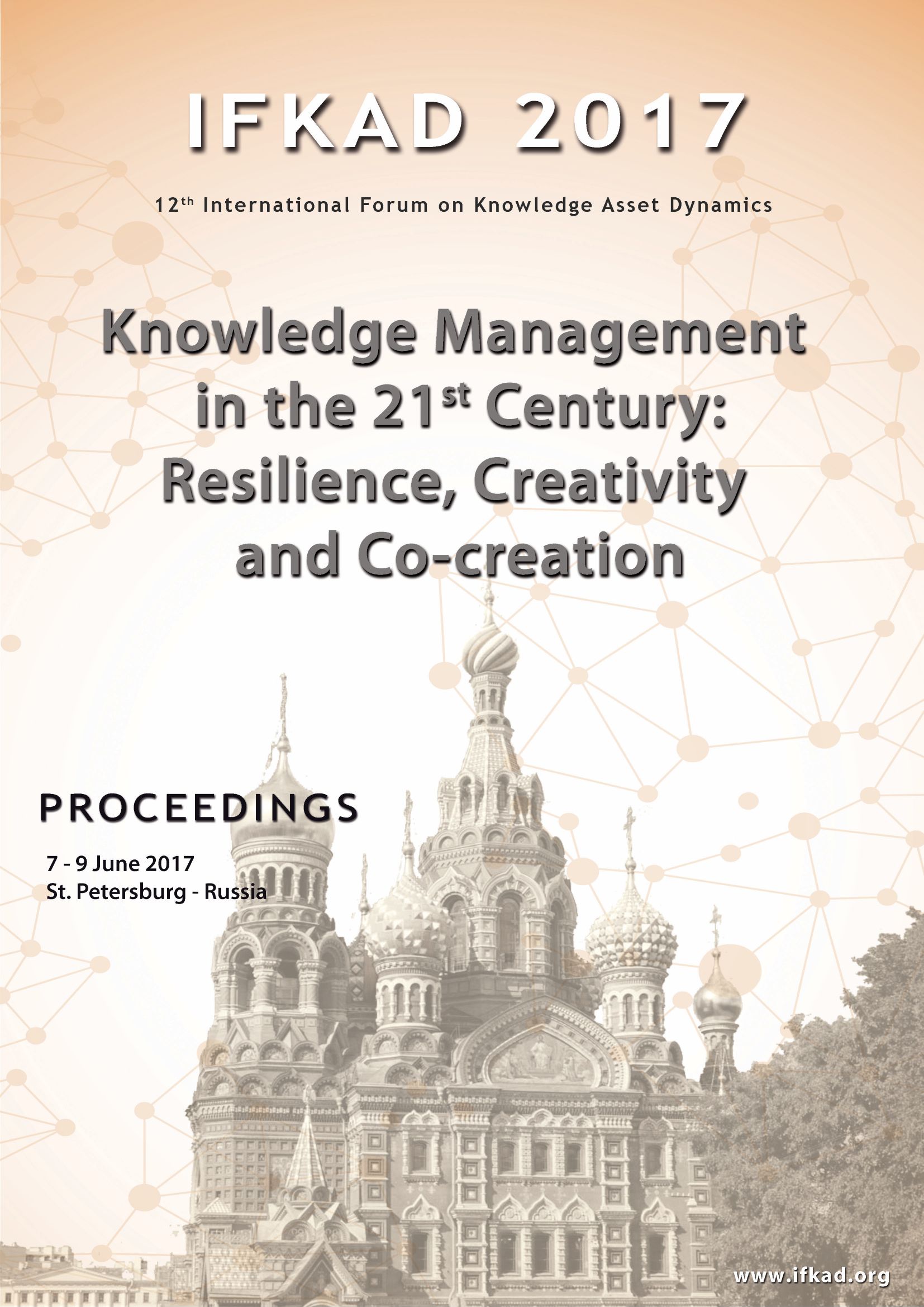
PROCEEDINGS e-books

Proceedings IFKAD 2017

Knowledge Management in 21st Century: Resilience, Creativity and Co-creation
List of Included Articles:
(How) are Southern Brazilian firms managing knowledge for innovation?
Guillermo Antonio Dávila, Tatiana,reeva, Gregório Varvakis

This paper explores what knowledge governance mechanisms can be particularly relevant for innovation in the Brazilian context. A sample of 111 firms from Southern Brazil was surveyed. Hypotheses were tested using structural equation modelling (SEM). Our paper contributes to the knowledge governance and innovation literature by demonstrating that in the Brazilian context, infrastructural knowledge governance mechanisms are more important than people-focused ones. This study brings valuable information to managers of Brazilian firms to allow more efficient allocation of their resources and efforts for managing knowledge, and ultimately, innovation.

Innovation capabilities: What are their characteristics and how can they be conceptualized?
Tor Helge Aas, Karl Joachim Breunig

It has been argued that firms may utilize their resources and capabilities through the development of innovations in the form of new products, services or processes, and empirical research has confirmed that there is a positive relationship between the implementation of innovation activities and future performance of firms. Some firms prove to be better at reproducing innovation success than other firms, and the capacity to do so can be framed as an innovation capability. However, the term innovation capability is ambiguously treated in extant literature. There exist several different definitions of the concept and the distinction between innovation capabilities and other types of capabilities, such as dynamic capabilities, is neither explicitly explained, nor is the relationship between the concept and other resource- and capability-based concepts within strategy theory established. Even though innovation increasingly is being pointed to as crucial for firms sustainable competitiveness in contemporary volatile and complex markets, the strategy-innovation link is underdeveloped in extant research. To overcome this divide this paper contributes with a conceptual framework to discuss innovation capability. Due to the status of the extant research, we chose a conceptual research design to answer our research question. Based on careful examination of current literature on innovation capability specifically and the strategy-innovation link in general, we suggest to analyse innovation capability along two dimensions – innovation novelty and market characteristics. This enable us to identify four different contexts for innovation capabilities in a two-by-two matrix. Subsequently, we discuss what types of innovation capabilities that are expected to be required in the four different contexts. We report on, and synthesize, current understanding of innovation capability and provide a framework to discuss different contexts for innovation capability. The provision of this framework contributes with new knowledge on the strategy-innovation link as well as clarifying the conceptual understanding of capabilities within the strategy literature and establishing the relationship between these underpinnings and innovation management theory. In particular, we present a contingency perspective on variation in innovation capability related to the four identified contexts. The conclusions reported in the paper provide assistance to managers searching for better ways to manage their innovation capabilities, by providing a framework for discussing how innovation novelty and market characteristics affect the innovation capabilities required in different contexts.

Measuring cognitive spaces for learning processes
Francesca Jacobone, Donato Morea, Gilberto Tonali

The purpose of this paper is to shed a fresh light on cognitive landscapes in which humans and their organizations learn, decide, operate and improve their creative circles. According to Berthoz, human brain manages the complexity of an environment, by creating “virtual worlds” and making “complex simplifications” (defined as simplexity). Essential parts of this process are: a) redundancy of available solutions; b) active intention; c) creation of virtual worlds, with internal Newtonian laws. This ability deeply wired in the brain has been widely analyzed in the recent literature. We intend to contribute to this debate highlighting that also space has fundamental aspects for human cognition and learning; and that measuring and tuning the outside space, as well as the internal, virtualized and social cognitive space, can give us valuable insights. Building on a previous work where we measured distances in organizations (people, teams, offices, tasks), in this paper we aim to measure and compare physical distances in buildings (offices, museums, public places) with virtual distances, as they are perceived by the people that use those places – permanently (as employees) or temporarily (as guests and customers). Measures of spaces are then obtained both through physical measurements and surveys. We intend to build then oriented graphs and adjacency matrixes, in order to further analyze how the architectural features of the place can be positively or negatively correlated to the cognitive and learning effort of people. Very little is known about the way non-conventional places, including both virtual and social places, may be creatively managed to foster cognitive and learning processes of people. Learning processes can be modeled as a set of layered closed loops that start from the biological level and evolve towards the most abstract levels. We intend first to map and measure the space where cognitive and learning processes develop. Then we aim to introduce a novel approach to define “distances” among these spaces, starting from the pure physical places, up to virtualized and social cognitive spaces. To this purpose we will use a wide array of mathematical tools, up to the latest tools included in the connectionist field of Artificial Intelligence; i.e. Artificial Neural Networks. Indeed, ANNs have gained recent popularity due to outstanding success in so called “Big Data Deep Learning”. In our final section, we’ll present some relevant examples of them. Our study, focused on mathematical treatment of distance matrices between formal and informal systems, may help to make visible many valuable, hidden information, in a pure bottom-up, data-driven fashion, that can help to develop learning processes, in their own well-engineered space.

Competences of Business Model Innovation – competences that create, capture and deliver Business Model Innovation
Jane Flarup, Signe Stagstrup Jensen, Peter Lindgren

Business model innovation is based and created on behalf of “raw materials” such as knowledge or competences (Technology, Human Resource (HR), Organizational systems and culture). Societies are these days lacking competences (EU 2016) that are capable to create, capture and deliver enough Business Models (BM) to present or new Business Model Eco Systems (BMES). Many BM do not even reach BMES successfully because they lack the competence to reach the BMES. If this process continues too many times businesses – both established and non-established (startups) businesses are in risk of falling behind, falling out or as mentioned earlier not even reach the BMES. Access to excellent Business Model Innovation (BMI) competences are therefore extremely important and more and more critical to our society – but not least to businesses at all stages in their lifecycles. The hypothesis is that some Humans have BMI competences and it has for a long time been well known that some valuable BMI competences can be found among young university students. These students can create, capture and deliver new and different BM´s – even BMES which have turned out to become some of the worlds largest businesses (Stanford University – Google (Wikipidia 2017(1), Harvard University – Facebook (Wikipidia 2017(2), Oxford University – Younoodle, Quid ) (Wikipidia 2017 (3), MIT/Standford University – Younoodle (Youtube 2017). BMI competences among our young university students can however maybe and potentially be increased in the favour and in the value of our businesses and society if we are able to “spot” “the genes” or “DNA of BMI” in our students at a very early stage of their study at the university – maybe even when they enter the university. The paper intends to continue the journey of building up knowledge, language and a screening framework on BMI Competence – The BMI DNA. On behalf of a literature study on BMI competences and a previous preliminary study on a small sample of university student based business startups (Flarup et al, 2016) this paper increase the study to a large “databank” with quantitative and qualitative university student competence data. Combined with interdisciplinary research study of a large sample of engineering students at Aarhus University in Denmark a preliminary BMI competence profile related to BMI is proposed. Special focus in the longitudinal research has been on BMI projects in teams BMI Competences, characteristics and potentials as future BM´s and BMI seems to be more based on interdisciplinary BMI.

Design of Cognitive Applications on IBM Bluemix Cloud Platform
Alexander Viktorovich Sorokin

The presentation describes of IBM approach to creation of cognitive tools solving life tasks and creating new value. The cloud and cognitive technologies are important part of company’s strategy called CAMSS (Clouds, Analytics, Mobile, Social and security) aimed at transition of IT businesses to Web 3.0. The main audience of this presentation is faculty and university students. In the educational purposes, the experience of students Hackathons on design of cognitive applications IBM Watson run in Moscow and St. Petersburg in 2014-2015 used in design process.

Performance analysis in emergency departments: a data-driven approach
Alessandro Stefanini, Davide Aloini, Riccardo Dulmin, Valeria Mininno

This paper aims to investigate the process performances in Emergency Departments with an innovative data-driven approach. This approach permits to gain insights into the Emergency Departments processes showing the entire patient-flow, deploying the performances in term of time and resources on the activities and flows, and identifying process deviations and critical bottlenecks. Moreover, the use of this methodology in real-time might dynamically provide a picture of the real situation inside the Emergency Department in term of waiting times, crowding, resources etc., enabling the management of patient demand and resources in real-time. The proposed methodology exploits the process-mining techniques. Starting from the event data inside the hospital information systems, it permits automatically to extract the patient-flows, to evaluate the process performances, to detect process exceptions, and to identify the deviations between the expected and the actual results. The proposed approach was tested with a real case study inside an Emergency Department. This study responds to the need of novel approaches for monitoring and evaluating processes performances in the Emergency Departments, a particular area of attention for the public opinion and national authorities. The novelty of this data-driven approach is the opportunity to timely connect performances, patient-flows and activities. The suggested method supports the hospital managers in performance and process analysis inside the Emergency Departments. Starting from the results provided by this system, it is possible to explore the root causes of deviations, devise improvement actions, and evaluate the effects of corrective actions.

Analyzing the effectiveness of using social media as a tool of conflict management in Yandex LCC
Daniil Muravskii, Anna Pavlysh

The paper aims at explicating the differences between using traditional online communication channels with consumers for conflict management purposes and building a communication platform using social media. In the paper a research design is presented which goal is to allow to compare the effectiveness of both models based on company data from one of the largest search platforms in the world – Yandex LCC. As a result, introduced is a system of factors, which are supposed to explain the differences in the effectiveness of using various online channels for consumer conflict management as they were determined by preliminary qualitative research. The study uses the results of in-depth interviews with various stakeholders in the process of conflict management through social media in Yandex LCC. The proposed research design is based on the need to measure the effectiveness of conflict management during a period of one year, during which the same 35 company specialists provided multi-channel customer support across a series of traditional and social media channels. The differences in the outcomes of the studied practises are further supported by data from consumers about their attitudes and perceptions of various communication channels. As this research is dedicated to studying and empirically testing the above mentioned issues and questions, its outcomes have implications both for practitioners and scholars. The results of the study could be directly implemented by other major search platforms companies. In the paper, directions for improvement of KPIs for customer support divisions of search platforms are introduced, which would allow to make more precise evaluations of the effectiveness of practises in customer support divisions.

Why don´t one maximizes database utilization in product and service development in manufacturing
Hannele Väyrynen, Marko Manu

This case study purpose is to identify those factors that could promote external or organization internal information system data utilization, customer co-creation with external networks. The focus of this case study is on how organization can utilize existing databases with identified best practices to create added value for the customer in order and supply processes. This paper describes the pilot of the case study that explicates the status or restrictions and challenges of the databases´ utilization. These descriptors are derived from the literature and the pilot survey of the identified challenges. This methodology puts in evidence that more effort could be dedicated developing organization internal practices. Identified challenges guide the core operators in sale and marketing and product development into integral practices for order and supply processes to realize customer oriented and productive processes. Through this study, the function is to expand understanding how the databases are capitalized to create added value together with the customer. The forthcoming process model guides how to use databases efficiently internally but also with the customers.

Interconnection between technology and Open Innovations (OI) in Creative, Digital and Information Technology (CDIT) Businesses
Narmina Rahimli, Eric W. K. See-To

The purpose of this paper is provide a systematic literature review on Creative, Digital and Information Technology (CDIT) businesses along with a conceptual framework in a context of innovations, business models and technologies in order to identify interplay with open innovation and provide future research gaps. Thus, in this study we want to combine both the concept of open innovation and CDIT in order to identify new forms of knowledge, innovations and business models within creative ecosystems as CDIT itself encompasses of both technology and innovation activities which makes it a good case for research. We propose an approach that consists of the systematic literature review. In order to meet the objectives of this study we apply a three step framework as suggested by Tranfield et al. (2003). The data for this study is primarily extracted from Web of Science. Thirty three studies relevant to our research objectives were selected for a final analysis. The results are presented through descriptive and context findings. Based on the results obtained we firstly, discuss findings and make suggestion for future research and secondly, propose a conceptual framework in the context of this study. This methodology puts in evidence that even though creative industries is an emerging research area it attracts researchers from various fields. It also showcases that creative industries create a good research domain to research nature of innovations, new business models and adoption practices of digital technologies in different regions. Finally, this study showcases how to expand and combine previous research of open innovation on creative industries. The outcomes of the application pose value for both academia and practitioners. As for academia, we believe that research gaps identified will contribute to improving current state of literature on creative industries and expanding it to open innovation paradigm. As for practitioners, the literature review has demonstrated that creative industries are seen as an important contributor to economic growth and innovation capability, however mechanisms that facilitate these activities need to be explored more in various contexts. Finally, discussions made through this paper will be also useful for regional development of creative industries.

Human Resource Management Systems in Knowledge-Intensive firms
Dmitriy Sokolov, Elena Zavyalova

Knowledge-intensive firms (KIFs) are considered to have significant peculiarities in terms how they form their human resource management (HRM) practices and policies. Yet, challenges of understanding the features of HRM systems in this type of organizations still remain in the literature. One of remaining problems might be related to the gap between human resource management and knowledge management literature. The purpose of this paper is to address this problem by discussing the features of HRM systems in KIFs derived from inherent characteristics of KIFs and knowledge work. The methodology is based on the analysis of contemporary and seminal theory stressing the system perspective on related issues. The innovative aspect of the paper involves the system perspective to investigation of features of HRM in KIFs. The study results in multilevel theoretical framework for analysis KIFs’ HRM systems. The findings contribute to the integration of literature from knowledge management and human resource management spheres.

The Montreal Multimedia Cluster and Sector: the Sources of a Creative Ecosystem Dynamic
Diane-Gabrielle Tremblay

Cluster dynamics are based on new forms of knowledge management and innovation, which are based on collaboration and co-creation between various actors and sectors. Processes of innovation are more and more based on knowledge collection, interaction between players, management and exploitation and these contribute to Creative Ecosystems, including in the multimedia sector. There are various forms of collective action and collaboration used in order to attain various objectives; collaboration can take the form of simple networking, crowd-funding, crowd-sourcing, or integration of IT, amongst others. In our research, we wanted to determine to what extent cooperation and knowledge exchanges were developed in the multimedia and IT sector in Montreal, in order to contribute to a creative ecosystem in multimedia and IT. The research is based on qualitative methods, mainly documentary analysis and semi-directed qualitative interviews with various actors in the multimedia cluster and sector, including governmental organizations, intermediary organizations, as well as firms and training organizations. This research highlights the importance of Intellectual Capital and Knowledge Assets in New Economy organisations and in the development of a creative cluster and ecosystem. It stresses the sources of the dynamism of the sector which rest in the cultural embeddedness in the Québec society and business, in intellectual capital and knowledge transfers and exchanges. It shows that proximity of actors and the creative dynamism of the local human resources are determining factors to develop the multimedia cluster. The value of the research rests in the identification of factors favouring the development of clusters in general (proximity, cultural embeddedness, etc) and their contribution to Creative Ecosystems, as is the case for the multimedia sector. The outcomes of the research rest mainly in the possibility of helping implement efficient policies for the development of clusters and ecosystems in the multimedia, IT or other sectors. The research can also help creative firms understand how they can use the cluster theory and policy in order to support their creative activities and be more innovative.

The Living Lab: a method of creativity and innovation
Arnaud Scaillerez, Diane-Gabrielle Trembly

It is difficult to measure the impact of the implantation and the activity of a third place within a given territory, as the contexts and objectives vary widely. Oldenburg (1991) defines a third place as a place halfway between private life and working life. This place must be neutral, accessible to all, conducive to exchanges and facilitating encounters. Boshma (2005) presents these social interactions as stimulating the momentary rapprochement between several actors who frequently meet in this place to produce an intangible or material good that will last even after the end of these exchanges. Our communication aims to present the impact of several LL methods on a territory and the creative and innovative results that can result. Indeed, is it possible to categorize the LL approach? And what is the territorial impact of such an approach? Research ground: We will present four collaborative working methods that have modified four territorial sectors of the City of Montreal. Three living labs and four territorial projects have been documented. Qualitative method: Our research is based both on theoretical research and on interviews. These interviews were semi-directed and the interview grids included open and closed questions. Conceptual frameworks – A LL acts on the awareness of belonging to this territory, which further stimulates the consultation. The theory of collective identity developed by authors such as Touraine (1985) or Polletta and Jasper (2001) can then find an echo within the approach. These theorists define the collective identity as a bond uniting a community, interacting in order to carry out a collective and concerted action. A LL is a third place that stimulates meetings between a wide range of actors from all walks of life who are asked to contribute their expertise or opinions on a given territorial question. It is a research method based on the knowledge sharing of multiple actors, including actors involved in the project and its effect on the territory. Practical Implications – The LL’s approach stimulates collective action and enriches it even through a search for meaning, or even an identity quest, as well as a reinforcement of the spatial contextualisation, as we shall try to show with the cases of the three LLs of our research.

The value of co-creation and design science research in developing a Digital Health Innovation Ecosystem for South Africa
Marlien Herselman, Adele Botha

The purpose of this paper is to indicate what value was co-created with various stakeholders when Design Science Research as a methodology was applied, to develop a Digital Health Innovation Ecosystem (DHIE) for South Africa. Design science research as a methodology was applied which also involves design thinking. This methodology focuses on the creation of new knowledge and it is a research procedure for producing innovative constructions intended to solve problems faced in the real world. The value is to make a contribution to the theory of the discipline in which it is applied and this regard the discipline is Health Informatics. The outcome of the application of co-creation where different stakeholders were involved resulted in the development of a Digital Health Innovation Ecosystem for South Africa. This type of ecosystem has never been developed before with the involvement, feedback and contributions of the various stakeholders in South Africa. The development of the ecosystem went through various iterations/phases based on the methodology of Design Science Research. It was found that the most essential elements in this ecosystem should be the context that encapsulates the co-creation dimensions of social, technological, economic, environment as well as value-based ethics (better known as the STEEPV model) with various stakeholders, as depicted in the different layers of local, regional, national and international dimensions evident in an innovation ecosystem. Under innovation, the importance of applying a specific innovation process (Open Innovation 2.0) is important where stakeholders and users are involved to co-create. The role of users and stakeholders is very prominent as it was indicated in the workshops to be the essence of customising or localising digital health innovations to fit the needs of the consumer or patient. The greatest challenge and opportunity for preventive health innovation lies in closing the gap between what we know and what we do. This includes attitude and behavioural changes by many different stakeholder groups. This ecosystem development through co-creation stimulated the National System of Innovation in South Africa as the lessons learnt from this development informed organizations, the health industry and government of South Africa. It also contributed to the body of knowledge on co-creation and value creation even though it was applied in the health sector.

The reasons of coopetition in low-tech industry
Maciej Rzadca

The subject of the research work is characteristic of coopetition in the low-tech SMEs in Poland on the example of the brewing industry. The author intends to combine the two streams of research dealing with issues of cross-organizational cooperation: coopetition theory and network theory. We propose an approach of interpretative symbolic paradigm, qualitative research method, use of grounded theory and data collection will be made by interviews. The economic and management literature has largely stressed the importance of knowledge assets for company’s competitiveness. By using a multi case studies analysis (the author plans to make conduct studies in 30 organizations), stresses the importance of taking knowledge assets into consideration as value drivers that can support NPD process performance improvements. Majority of research was conducted in large and/or hi tech companies, also the author is interested in two main factors: how small low-tech companies can establish and profit from coopetition and are there any differences between low-tech and hi-tech coopetition networks in regard to knowledge sharing and success factors. After initial studies, the author wants to verify whether, in the emerging economy there exist other, additional factors effect on coopetition between organizations. An additional aim of the researcher is to identify similarities and differences between the emerging markets and countries with a stable economy. Because the author wants to focus on the countries belonging to the emerging markets, which were not carried out before this type of research will be possible to better understand the conditions in these markets. the author wants to examine how the phenomenon of coopetition, which has been very well described in the hi-tech sectors and in large organizations, can be used by small organizations belonging to the low-tech industries. An additional aim is to show how knowledge is distributed in conditions of very little trust. Through an analysis comparing organizations present in several countries that belong to traditional industries, it will be possible to develop effective rules within coopetition.

Explaining e-business adoption and use in Mexican exporting SME’s. Development of a measurement model from the perspective of Knowledge Management
Celestino Robles Estrada, Juan Mejia-Trejo

Small and Medium Enterprises (SMEs) are the backbone of the economy, and they significantly benefit from Knowledge Management (KM) to develop competitiveness throw innovation, however the extant literature has little empirical support for this statement. Dating from the early 1990s, the increased use of technology has brought about numerous changes in the business world, and electronic business (e-business) has become a paramount innovation for business. This technology not only introduced a new way of doing business, but also has become a vital part of peoples’ lives. The purpose of this paper is to develop a research model aimed to explain e-business adoption (EBA) at firm level, from the perspective of the Knowledge Management View (KMV). Using the literature review this paper develops a theoretical construct aimed to explain EBA in SMEs. It initiates with an introduction to the study of KM, then, the relation is analyzed between KM and innovation and deepens into the relation between KM and EBA. Finally, a conceptual framework is constructed and research propositions are developed in order to establish EBA as a dependent variable that can be explained by KM. Although studies on Internet adoption by businesses have proliferated in the last few years, this kind of research has, however, been limited or null in some developing countries like Mexico and only few studies have been developed to explain EBA in SMEs from the perspective of KM. The proposed model is part of a theoretical-empirical research project aimed to explain e-business adoption in Mexican SMEs Past studies have mainly focused on studying EBA from the innovations adoption theory perspective, using variables such as environmental, organization attributes as well as innovation’s attributes. This study addresses the previous scarcity of literature on the relationship between KM processes and EBA. These results have implications for e-business managers in formulating policies and targeting appropriate organisational capabilities to ensure the effective adoption of e-business, nevertheless, the research model needs to be tested empirically to prove its real value.

The Art of War? The Role of Cultural Distance in IJVs’ Knowledge Management Processes
Rubens Pauluzzo, Maria Rosita Cagnina

The role played by cultural distance in affecting IJVs’ knowledge management is not well understood as there is still a lack of consensus among the main literature. First, the influence of cultural differences on IJV’s knowledge management has generated contradictory results. Second, how and why national and organizational culture affect IJV’s knowledge management remain vague. The main aim of this study is to fill this gap in the literature, by investigating how the dynamics of national and organizational culture influence knowledge management processes in IJVs operating in a cross-cultural business environment. We adopted a cross-case analysis, based on an embedded case study (the IJVs of the Generali Group in China with China National Petroleum Corporation and in India with Future Group). We used multiple sources of evidence: interviews, field observations, and internal document analysis. We performed cases analysis following a four-step method: within-case analysis, data reduction, cross-case analysis, and conclusion drawing/verification. In order to provide a more systematic visualization and comparison of all the cases at once, a meta-matrix by categories and research questions was also displayed. There is still a lack of consensus about the exact nature of the relationship between cultural differences and IJVs’ knowledge management. What kind of impacts does cultural distance have on IJVs’ knowledge management? Which is the role of national and organizational culture in affecting IJVs? Do they have a direct or mediated influence on IJVs’ knowledge management? There is still a lot of debate about these questions and a deeper knowledge of how national and organizational culture are interrelated and affect IJVs’ knowledge management processes is therefore needed. The paper provides managers with guidelines on how to cope with cultural distance issues when dealing with IJVs’ partnership processes (negotiating terms, managing the IJV, transferring and managing knowledge to the IJV).

Knowledge transfer, university system and networking settings in competitive and uncompetitive regions: an international comparison
Andrea Cardoni, Domenico Celenza, Rosa Lombardi

The purpose of this paper is to analyse knowledge transfer in the university system and networking settings through a literature review and by adopting, in the future, an international comparison between competitive and uncompetitive regions in the current scenario (Huggins, Johnston, 2009). Following this aim, the paper presents the characteristics and differences between social and capital networks (Aiken, 2010; Chakrabarti, Rice 2003; Cheng-Nan et al. 2007; Huggins, 2010) as well as hybrid and institutional organizations to define the knowledge transfer model useful within an international context. The analysis has been developed, in this first phase of the research, through the review of literature. This current analysis is the first step of our research aimed at showing how the knowledge transfer is activated by universities (Dearlove, 2002) and which is the best networking model able to support knowledge sharing in different regional contexts (Cardoni, 2015; Clark, 1998; Etzkowitz, 2008; Goddard, Kempton, 2011; Guerrero, Urbano, 2010; Gunasekara, 2006; Trequattrini et al., 2015). We propose a qualitative approach based on a comparison between competitive and uncompetitive regions of different countries in order to recognize which university model and networking setting can facilitate knowledge transfer towards the territory. The sources of the paper are of a secondary nature. Several articles, documents, books and websites have been consulted. This methodology highlights the knowledge transfer activated by universities and networks towards the environment and points out the differences and provides suggestions in order to improve the knowledge transfer of the traditional university model. In this way, the current research contributes towards expanding the international literature on the topic of knowledge transfer. The major implication of the paper is to find the characteristics and differences between competitive and uncompetitive regions through a future international comparison. However, findings of the paper are aimed at introducing suggestions towards the activation of knowledge transfer in traditional universities.

SME strategic networks: how to achieve the commitment of partners
Lara Agostini, Anna Nosella, Karen Venturini

To hinder the high failure rate of strategic networks, recently scholars have concentrated on behavioral aspects such as trust, conflict management, resolution and commitment as fundamental antecedents of strategic network performance (Christoffersen, 2013). Within this context, this article focuses on the antecedents of commitment, based on the rationale that high levels of commitment cannot occur naturally during network evolution. Therefore, this article aims to understand how commitment is achieved along the development process of SME strategic networks. To address the aim of the article, a qualitative approach based on multiple case studies was used. This method is generally more suited to deal with “how” research questions and when researchers want to understand a real-life phenomenon in depth (Yin, 2013). Two case studies of Italian SME strategic networks having an increasing and decreasing level of commitment were selected to have a base of comparison, following a ‘polar types’ theoretical sampling approach suggested by Eisenhardt and Graebner (2007): Case 1 and Case 2 are both alliances of 12 partners offering complementary products and services in the automotive and automation industry respectively. The study makes a noteworthy academic contribution to theory concerning commitment in a SME strategic network context. Its main value consists in providing an in-depth and overarching investigation of the antecedents of partners’ commitment, which is supposed to be one of the determinants of network success, as anticipated. By comparing two cases in which partners show a different level of commitment along the network development process, this study allows to provide a twofold contribution. The former is to unveil the most relevant elements partners may rely on to achieve a high level of commitment and the latter is to propose a dynamic approach towards the study of commitment in SME strategic networks. The article provides a series of practical guidelines for managers. In particular, SME entrepreneurs and managers may profit from specific indications regarding which are the factors that influence the commitment of partners and how to increase it throughout the network development process. SME strategic networks are a useful mean to overcome the economic crisis and to open up to international markets. For this reason, it is necessary to study in detail the elements that can support the survival of this kind of networks and their strengthening.

Educating innovative leaders for the unordered world of VUCA
Clive Holtham, Ann Brown, Maryann Kernan, Martin Rich

Our focus is on how VUCA impacts on conventional management education, and in how novel educational activities are required to augment management education so it more successfully addresses the challenges of VUCA. We developed an approach based on participatory action research into the development of new learning methods to support managers in coping with VUCA. It presents a case study of an institution which has explicitly sought to develop new forms of learning for developing innovative managers, and the experiences in three innovative learning approaches are compared. In this research a focus was on the lack of order faced by top managers, and on why and how new educational methods are needed to address this. Use was made of a specific lens arising from complexity science, namely the Cynefin framework (Kurtz and Snowden, 2003; Snowden and Boone, 2007), to analyse the high level education implications of VUCA in non-military organisations (Bennett and Lemoine, 2014). Cynefin is a sense-making framework which divides contexts into two domains – order and unorder. Originality/value –This methodology involves an approach based on participatory action research into the development of new learning methods to support managers in coping with VUCA. It examines an institution which has explicitly sought to develop new forms of learning for developing innovative managers, and the experiences in three distinct parallel approaches are compared. The outcomes challenged one approach being proposed to addressing VUCA, namely to simplify solutions into “antidotes” e.g. Johansen, 2009. This search for antidotes means deploying the formulaic approaches developed to “solve” order. This study concluded that it is fruitless to deploy the tools of order, to solve an utterly different type of problem, namely unorder. The educational emphasis needed to be on developing personal qualities of current and future managers, and they needed to be developed through experiential learning approaches, rather than the transmission of formal knowledge and recipes. Overall, the action research concluded that it was feasible to develop innovative learning methods even within the parameters of a conventional institution.

Knowledge management and performance: has counter-knowledge an impact on this relationship?
Silvia Martelo-Landroguez, Juan Gabriel Cegarra-Navarro, Gabriel Cepeda-Carrión

This study investigates the impact of counter-knowledge on the relationship between knowledge management and business performance. Regarding this, much has been written about why it is important to manage knowledge but considerably less has been written about the role played by counter-knowledge in the different knowledge processes. Following previous attempts to identify and define the different knowledge processes, we propose the following processes as the main knowledge management processes required to increase firm performance: realized absorptive capacity, organizational memory, and knowledge application. Then we analyse the counter-knowledge’s influence on knowledge management processes and the possible impact on firm performance. A model is tested to examine the impact of counter-knowledge on the knowledge management processes and the firm performance on the Spanish banking industry from a quantitative approach. Specifically, we tested our hypotheses using a SEM approach based on composites (PLS). The unit of analysis is branch-office managers from the 15 banks operating in Spain in 2013. Data were collected from 151 branch-office managers. The assumption that knowledge management is an organizational capability implies that firms need to possess a set of resources in order to create, share, and use knowledge (Chou et al., 2007; Lin, 2007; among others). Therefore, organizations should have processes for sharing knowledge (i.e., organizational memory) and for using the knowledge created (i.e., knowledge application) in order to support the management of knowledge to increase business performance. Given the importance of external knowledge for the development and increase in employees’ knowledge and learning capabilities (Jantunen, 2005; Newey and Zahra, 2009), realized absorptive capacity also represents an important part of a firm’s ability to create new knowledge (Chou, 2005; Lane, Koka, and Pathak, 2006; Liao et al., 2010). The analysis of the role of counter-knowledge in this classic relationship is the value of this paper. The considerations discussed above allow us to put forward the argument that counter-knowledge plays an important role in knowledge management since it influences knowledge management processes (i.e., realized absorptive capacity, organizational memory, and knowledge application). According to Cegarra, Eldridge and Gamo (2012), counter-knowledge can be seen as a natural deterioration or depreciation of organizational knowledge, usually with negative consequences for customers. This paper tries to support empirically the effect of counter-knowledge in the knowledge management processes and firm performance.

Proceedings IFKAD 2017
Knowledge Management in 21st Century: Resilience, Creativity and Co-creation

Submit the following information to receive the download link 

a valid email address where the download link will be delivered