PROCEEDINGS e-books

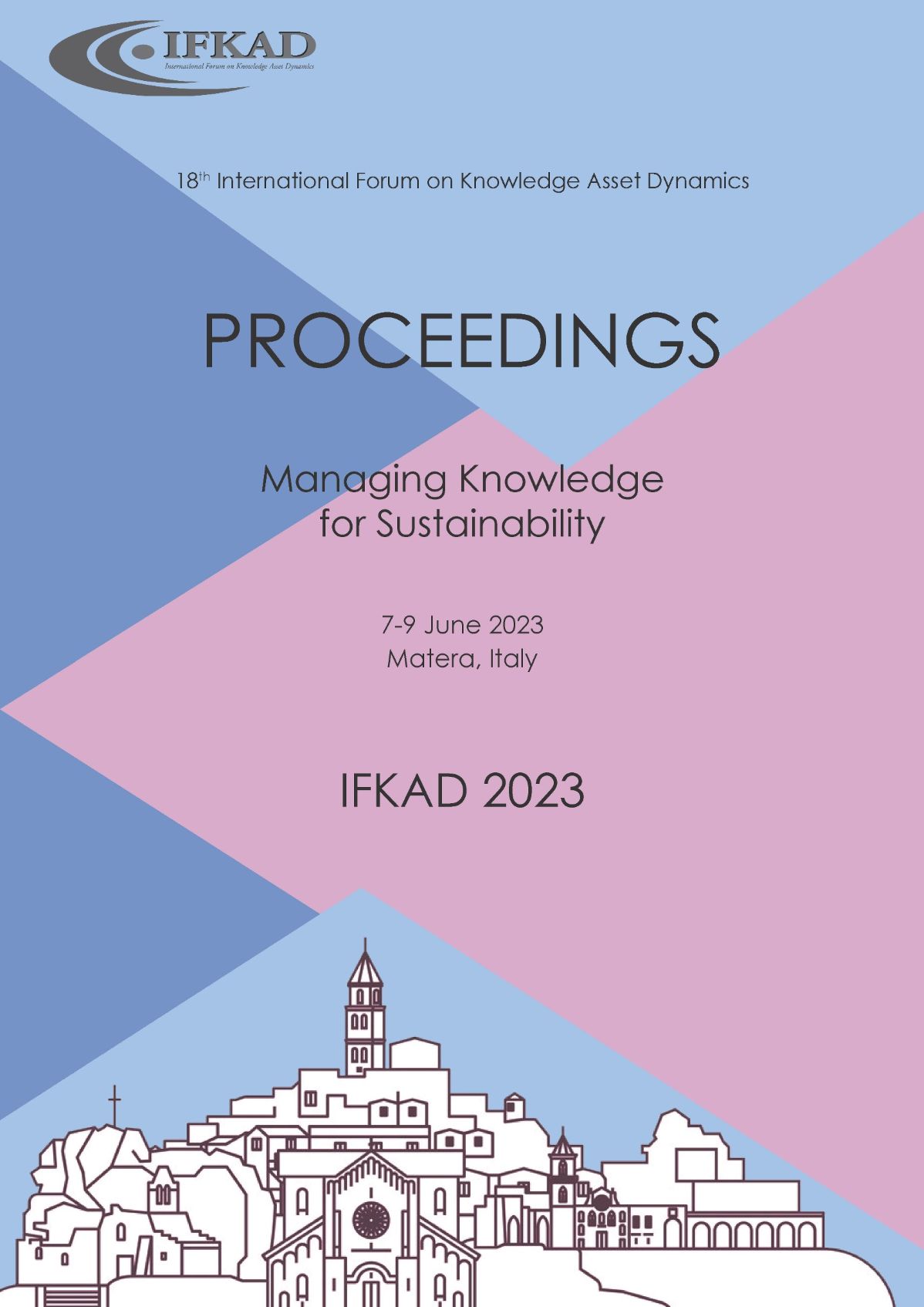
Proceedings IFKAD 2023

Managing Knowledge for Sustainability
List of Included Articles:
Intellectual Capital Framework and Athletes with Disabilities: The Example of Bebe Vio
Roberto Aprile, Susanne Durst

This paper tests the intellectual capital (IC) framework dedicated to elite athletes proposed by Aprile et al. (2022) on the Italian Paralympic champion Bebe Vio to determine the usefulness of this framework and its components. To do so, the study is based on primary and secondary data from and about Bebe Vio. The findings underline that the IC framework offers a solid approach to determine and learn about the IC of elite athletes (regardless of its type). Additionally, the findings indicate areas that could be added/extended to successfully determine the IC of these persons.

The Impact of Ethical Leadership on KM Practices and Performance
Susanne Durst, Serdal Temel, Samuel Foli

Considering the relevance of leadership to sustainable business development (Hind et al., 2009; Kurucz et al., 2017; Pham and King, 2019), in this paper, we examine the relationship between leadership and organizational performance. More precisely the focus is on ethical leadership which has been defined as “the demonstration of normatively appropriate conduct through personal actions and interpersonal relationships, and the promotion of such conduct to followers through two-way communication, reinforcement, and decision-making” (Brown et al., 2005, p. 120). Ethical leadership has found to be relevant in situations of change, as followers appear more satisfied with ethical leaders, which in turn motivates them to perform better, engage in more organizational citizenship behaviours, and also enjoy higher job satisfaction (Sharif and Scandura, 2014). A recent study by Ali et al. (2022) has also shown the positive relationship between ethical leadership and organizational learning. At the same time, empirical research on the impact of ethical leadership on organizational performance, however, is still limited (Dey et al., 2022). Acknowledging the role of knowledge for sustainable business development (Abbas and Sağsan, 2019; Durst and Zieba, 2020), we argue in this paper that ethical leaders will emphasis and promote continued knowledge creation and knowledge networks to contribute to the firms’ organizational performance (Rhee et al., 2022; Li et al., 2009) and thus their sustainable development. The remainder of this paper is structured as follows. We first briefly address the literature background of this paper. We then explain the methodology of the research. This is followed by the presentation and discussion of the results before we terminate the paper with a conclusion.

Knowledge Risks Arising from Digitalization
Malgorzata Zieba, Susanne Durst, Martyna Gonsiorowska

This conceptual paper aims to identify and analyse knowledge risks resulting from digitalization. Additionally, the paper tries to present factors influencing knowledge risks arising from digitalization and ways of handling them. The study is a continuation of the research by Durst and Zieba (2019) related to knowledge risks and their potential outcomes. This present study makes an update on the literature on knowledge risks arising from digitalization. The paper offers new insights for researchers dealing with the topic of knowledge risks in the context of digitalization and ways of handling them. The study provides insight for each of us, as the issue addressed concerns us all. By becoming aware of the potential consequences of such knowledge risks, people may meet and cope with digitalization in a better, more enlightened way. The presented paper is based on prior literature and the authors’ reflections, experience, and analysis. Thus, to check for the suitability of the risks proposed, there is a need for empirical studies. Such studies are planned by the authors in the near future.

Knowledge Management and Metatheory in a BANI World
Yasmina Khadir

The purpose of this paper is twofold: (1) to understand how knowledge management failed to fulfil its promises and became a blurred field of research that gets increasingly diluted in adjacent fields, a catch phrase referring to an eclectic group of intangible phenomena related to learning and roughly to any organizational situations using the word ‘knowledge’; (2) to explore how the use a meta-theoretical analysis may suggest a way forward that moves away from eclectics to unity and highlight the potential KM holds for organizations striving to manage organizational knowledge within turbulent times. Considering the persistence of the conventional rational-cognitive obsession with recipes and the slicing and dicing of organizational knowledge in well-defined, circumscribed, and quasi-observable sub-domains, is timely. This widely spread inclination in objectifying and reifying knowledge fails to help organizations navigate the complex business environment of this first quarter of the 21st Century. Contemporary organizations are compelled to manage knowledge within a VUCA or BANI world. More than ever, firms must consider holistic perspectives enabling the management of an ambiguous and elusive organizational knowledge, while acknowledging the complexity or crisis state of our current world. Practitioners and scholars must go beyond the simplified assumptions currently available in mainstream literature. The following research question guides the study: What does a meta-theoretical study about the evolution of knowledge management reveal on its inherent ontological and epistemological assumptions, and how can this support scholars and practitioners to make most of a VUCA context? Through a meta-theoretical analysis, this paper endeavours to highlight how the field has come to this situation. It attempts to refocus the audience attention on the kernel of organizational knowledge, mechanisms, and dynamics. Meta-theoretical analyses on knowledge management are rare provided that the field is taken for granted and that trends seems to define the field and how it evolves.

A Performance Measurement and Management System for Representing Economic, Social, and Environmental Impacts: A Pilot Case Study
Alessandro Rizzi, Giorgio Torchio, Enrico Sorano, Davide Genta, Alberto Sardi

Numerous scholars and scientific areas are investigating sustainability. Usually, it is drawn up by specific reporting which describes the economic, environmental, and social impacts of the organizational activities. One of the main approaches for drawing up this report has been developed by Global Reporting Initiative (GRI). It defines a list of standards useful for the description of the impacts; however, these standards rarely address business management through performance measurement and management systems. Through a pilot case study, the paper aims to represent the GRI standards and the stakeholders’ needs through performance measurement and management systems. The findings describe a useful approach to represent the GRI standards and the stakeholders’ needs to illustrate economic, social, and environmental performance suggested by the GRI Standards and stakeholders’ needs.

Integrating SDGs in Supply Chain Performance Measurement: A Multiple Case Study
Roberta Ciccola, Maria Serena Chiucchi, Giacomo Pigatto, Lino Cinquini,,rea Tenucci

In today’s competitive environment, measuring and managing the sustainability performance of supply chain is fundamental as organizations are considered responsible for their harmful impact as well as for their contribution to sustainable development beyond corporate boundaries. The purpose of this paper is to investigate if and how organizations embed SDGs and their targets in their supply chains and how the impacts on SDGs can be measured and assessed. To this aim, a multiple case study involving four Italian companies is adopted. Our insights show the main supply chain practices implemented across the entire supply chain in order to achieve sustainability and SDGs. Furthermore, the preliminary findings show that performance measurement practices are critical enablers to install a sustainability and SDGs oriented culture closing the knowledge gap with the various actors of the supply chain, especially those who exhibit a lower awareness of environmental and social issues. However, some barriers to the measurement of supply chain impacts on SDG targets are identified. In so doing, this paper contributes to prior studies on sustainability supply chain literature by providing empirical evidence on supply chain strategies and measurement practices to contribute to sustainability performance and realize a positive contribution towards the achievement of SDGs.

Digital Skills and Free Market Orientation for a Sustainable Development
Gustavo Morales-Alonso, Daniel J. Gallego, Yilsy M. Núñez, Antonio Hidalgo

Economic well-being within a society will ultimately depend on the productivity increases that occur at industry level. Digitalization and the use of ICT are tools of capital importance in this process. However, in order to scale up to industry level, they should first appear at an individual level. Having or not having ICT skills will therefore be crucial both for the individual (not to be left behind due to his/her digital divide) and the society (to keep up with the economic development of other regions). In this research we study the existing relationship between ICT skills and the free market orientation, both in its political and economic component. We find that ICT skills is a complex measure, that can interact with free market in some aspects and be independent in others. The use of on-line banking, communication technologies and the access to databases are not linked to free market orientation. But the ability to buy on-line is found to be positively correlated with free market orientation, which could speak of the existence of trust in the markets as a facilitator of on-line purchasing. Contrarily, on-line selling is negatively correlated with free market orientation.

Human Component in Sustainable Digitization: Towards a Conceptual Framework
Virginia Dolci, Alberto Petroni, Benedetta Pini, Leonardo Tagliente

Since the late 20th century, the introduction of digital technologies has revolutionized the way people interact with the world. This has led to the mass diffusion of the Internet, smartphones, global computer networks and virtual reality, which have become an integral part of people’s daily lives. This digital transformation has had a significant impact on all spheres of human activity, including work. In addition, unexpected events such as the COVID-19 pandemic forced organizations to digitize rapidly to conduct business, despite social restrictions. This has contributed to the emergence of new paradigms in the world of work. In manufacturing sectors, the industry 4.0 model using automation, robotics, artificial intelligence, the Internet of Things and additive manufacturing has enabled manufacturing companies to optimize processes, reduce costs and improve service efficiency. While digital tools have a positive impact on economic and environmental aspects, they also force organizations to reconceive the role of human activity in the workplace. This revolution in the world of work can, however, have both positive and negative implications for an organization’s human resources. It is the responsibility of organizations to choose whether to adopt a sustainable approach that balances economic, environmental, and social factors. Specifically, to preserve social sustainability, organizations should adopt human resource management practices that place human capital at the centre of the transition to digital workplaces. This requires providing employees with digital skills for decent and rewarding employment. This paper aims to provide an analysis on the topic of digitization and social responsibility, where humans are at the centre of interest for organizations. Conflicting views on the effects of digital transformation on social sustainability make this an important topic for research. To investigate this gap, we adopted a two-stage methodology. In the first stage, we conducted a systematic literature review to understand the most widely discussed research topics on the topic to date. Then, based on these findings, we conducted an exploratory case study. Specifically, this paper analyses a San Marino company operating in the medical sector. This case is particularly interesting in that it highlights the effects of social sustainability related to digital transformation, both from the perspective of the organization and the beneficiaries of the product/service. The case study will allow for feedback and empirical validation of what is known in the scientific literature.

Collaborative Network Formation in Robotics Digital Innovation Hubs: A Dynamic Capabilities Perspective
Jorge Tiago Martins

The field of robotics has witnessed unprecedented growth in recent years, with emerging technologies such as AI, machine learning, and the Internet of Things (IoT) transforming the industry. To capitalise on this growth, manufacturers are turning to collaboration opportunities with digital innovation hubs, to foster collaboration, experimentation, and learning in the field of robotics. However, the success of such hubs depends not only on individual capabilities but also on their ability to work together as a network. In this context, the constitution of a network of digital innovation hubs operating in the domain of robotics raises important questions about the role of dynamic capabilities in the formation and development and of the network. Dynamic capabilities are traditionally considered to be the ability of organisations to adapt to changing environments and markets by leveraging their resources and capabilities. In the context of a nascent pan- European network of digital innovation hubs focused on robotics in manufacturing, it is proposed that the dynamic capabilities of the network at a system level will play a critical role in the network’s development and activities. It is also important to acknowledge that effective knowledge management can enhance dynamic capabilities by allowing the network to leverage existing knowledge and acquire new knowledge to adapt to changing environments. This paper, focusing empirically on the analysis of DIH² – a nascent network of digital innovation hubs operating in the domain of manufacturing robotics, examines how dynamic capabilities can be developed and leveraged to contribute to the overall success of the network. Overall, the paper aims to contribute to the growing literature on dynamic capabilities by examining their role in the constitution of a network of digital innovation hubs in the domain of manufacturing robotics. By highlighting the importance of knowledge management in the development of dynamic capabilities, the paper provides insights that can inform the design and management of successful digital innovation hub networks, in cognate domains.

The Role of Digital Technologies for Environmental, Economic and Social Sustainability in Supply Chain Management
Vincenzo Varriale, Antonello Cammarano, Francesca Michelino, Mauro Caputo

The technological choices facing organisations are increasingly complex and aimed at promoting sustainable development. Recently, the concept of Industry 5.0 has laid the foundations for a digital transformation that drives companies to adopt sustainable approaches. Although there are various contributions investigating the link between sustainable production and digital technologies, there is still a lack of comprehensive research on the role of digital technologies in achieving the three pillars of sustainability in specific areas of supply chain management (SCM). The article aims to assess and understand which digital technologies are the most promising for achieving sustainability standards. Through a systematic literature review, the study analyses 1,720 scientific articles that identify business practices supported by digital technologies such as: 3D printing, artificial intelligence, blockchain, computing, digital applications, geospatial technologies, immersive environments, Internet of Things, open and crowd-based platforms, proximity technologies and robotics. Such business practices are thereafter associated with specific areas of SCM such as distribution, marketing and procurement. The results show that blockchain technology is promising for different sustainability aspects, whereas computing, 3D printing and immersive environments are less employed for sustainable development. The study also highlights that scholars have paid more attention to environmental rather than economic and social sustainability dimensions. The contribution of this article is to provide a current overview of digital technologies in SCM to clarify the state of the art of research. It also defines a research agenda for academics to conduct further exploratory research. For managers and practitioners, it presents a knowledge base where data on sustainable practices supported by digital technologies in SCM have been collected and organised, providing information to companies on opportunities for implementation in their own business.

Open Processes of Knowledge in Circular Enterprises
Sofia Mauro, Alessandra De Chiara, Luigi Sergianni, Anna D’Auria

The circular economy (CE) is experiencing increasing attention, as it has the potential to move away from unsustainable production and consumption patterns, such as the linear one. The circular innovation has even more considered an approach to be adopted in pursuing the sustainable development goals, embracing environmental, social and economic nature of sustainability. Starting from the above premises, our study aims to investigate how inter-organisational collaborations lead to the creation, sharing and exchange of knowledge with potential benefits for the companies involved, especially in terms of innovation. To achieve this, we observed the circular economy context since, as mentioned above, the interactions between different knowledge areas, as well as the interaction between different actors, are considered strategic keys to support and foster the transition to the circular economy. Furthermore, our paper also aims at contributing to the debate on industrial symbiosis and innovation processes in circular enterprises, focusing on knowledge management (KM), through the integration of different skills provided by local partners. The results underline that the collaborations with local actors are a phenomenon rooted in circular businesses, and that the interconnections between different and complementary knowledge and skills are fundamental to support circular innovation. Implications and suggestions for future studies derive about the knowledge management function both in managing knowledge flows to and from partners and in processing knowledge.

Investigating Circular Business Implementation’s Antecedents: An Empirical Assessment of Open Innovation and Digital Technologies Adoption
Francesco Antonio Perotti, Ciro Troise, Alberto Ferraris

More and more companies are winking at sustainability through the adoption of circular business models, which are based on resource and waste minimization to establish a renewable closed-loop production and consumption system. Departing from a linear take-make-use-dispose setting, circular economy principles lead businesses’ transition toward the development of circular products and processes. Drawing on past studies that associate circular businesses with the adoption of digital technologies or open innovation approaches, this research seeks to shed light on the role of openness in companies’ innovation approach and digital technologies in fostering a circular business model development. In this vein, the authors’ purpose is to quantitatively evaluate such elements as predictors of circular business model development and thriving. After pointing out some key features of the research, the paper concludes with the presentation of the expected findings and the discussion of the potential theoretical and practical implications of the study.

Food Supply Chain and Covid-19: Immediate Impact and Post-Pandemic Strategies
Eleonora Bottani, Barbara Bigliardi, Benedetta Pini, Marta Rinaldi

The food sector has been one of the industry fields most severely affected by the Covid-19 pandemics. The food industry, indeed, manufactures essential items, and as such, it is expected to continue supplying goods, despite the (even exceptional) external disruptions. This is why at the beginning of the pandemic period, there has been a great deal of worry regarding food production, processing, distribution, as well as significant changes in the demand for finished products, with various observed phenomena. The Covid-19 pandemic also had a negative impact on the food supply chain from a financial point of view, because of restrictions in labour, unavailability of suppliers and difficulties in quickly finding alternative vendors. This paper aims at summarizing the key issues experienced by the food supply chains during the Covid-19 pandemic and then at delineating appropriate strategies for building more resilient chains in the post-pandemic period. To achieve this stated aim, the chosen research methodology is the systematic review of the literature, as the food industry was one of the most investigated systems in the pandemic and post-pandemic era. Results are expected to categories the available knowledge about the role of Covid-19 on food supply chains, as well as to provide some useful guidelines for managing food supply chain in the future.

Unsupervised Learning AI-Data Management and Improved Lean Methodology in Healthcare Organizations
Angelo Rosa, Alessandro Massaro, Angelo Leogrande, Giuliano Marolla

In the following article, we apply a set of machine learning algorithms to analyse a set of 445 Californian Hospitals. We investigate a variable that can be considered as a synthesis of the economic, financial and organizational performance of the hospital i.e. Net Income. First of all, we have applied a regression analysis with OLS-Ordinary Least Squares to verify the presence of significant relationships among the variables in respect to Net Income. Furthermore, we have applied the k-Means algorithm optimized with the Elbow Method to verify the presence of groups of hospitals in the dataset based on more than 200 variables and centred on Net Income. Finally, we propose a comparison among eight different machine-learning algorithms to estimate the future value of Net Income based on an historical series in the period 2014-2018. Our idea is that the area of inefficiency that are showed thanks to the regression analysis can be optimized with the application of AI and Lean Management. Specifically, the efficiency of hospitals to manage human resources and specifically physicians can be improved with the application of telemedicine and organizational tools, that can increase either the performance of the hospital and the level of care offered to patients. The mix of Artificial Intelligence and Lean Management can promote better models in healthcare, reducing costs, improving the quality of services, increasing the level of human resources especially physicians, to create a more sustainable and reliable healthcare system.

Process Mining Applied to Lean Management Model Improving Decision Making in Healthcare Organizations
Angelo Rosa, Alessandro Massaro, Olivia McDermott

The paper introduces an innovative approach to model risks in healthcare finding possible solutions in organization models and about Human Resources (HR) managing. Specifically, the method is based on the application of the Business Processing Modelling and Notation (BPMN) workflows in healthcare environments merging Lean management methods and Artificial Intelligence (AI) decision making approaches. The discussion begins with a case study about risk management integrating AI to enable a Decision Support System (DSS) thus defining the innovative BPMN Process Mining (PM) models. The BPMN-PM models are based on AI risk prediction and AI risk classification suitable to optimise the whole HR organizational model. In the specific case study, the AI algorithms allows the optimization of risk assessment. Finally, the work discusses some theoretical BPMN-PM models to integrate in more complex healthcare processes managing efficiently HR. The proposed work provides information about the process design and the key-reading to interpret BPMN-PM workflows

The Role of Woman in Crisis Management: The Case of Sport-Based Entrepreneurship
Raffaele Trequattrini, Alessandra Lardo, Benedetta Cuozzo, Alberto Manzari

This paper investigates the role of women who hold top-level positions in the management of firms in managing and overcoming the corporate crisis. The research’s main goal relies on discovering the extent to which gender differences affect perceived crisis proneness/preparedness in organisational settings in sport-based entrepreneurship. In particular, we aim to study actions, decision-making, abilities, and opportunities women can exploit to strategically run the business during a crisis. The research question is answered through a single case study approach based on the basketball club “Virtus Cassino”, which participates in the Italian national Serie B basketball championship. We conducted semi-structured interviews with the woman entrepreneur. We analysed strategic business documents, the website, and articles published in the press on Virtus Cassino. Therefore, the female entrepreneur figure represents a vital aspect of the analysis conducted and the strategic management model of crisis management. The Ratten (2011) and Ahonen (2019) frameworks were used to test our results in achieving the research aims. Finally, a triangulation of the research results was conducted to attest to the integrity and reliability of the data. The paper enriches the literature on gender and crisis by providing a strategic management model for crisis management in sports entrepreneurship, guided by a female entrepreneur. The results of this research contribute to the literature also on sport-based entrepreneurship and entrepreneurship theory, identifying the strategic levers of crisis management guided by a female entrepreneur, including intangible elements such as the manager’s entrepreneurial skills, the cultural background of the factors, the relationships established by the sports club with fans and specialized figures in the sector. This model helps to understand how the role of women, even in sports enterprises, can be considered valuable for overcoming corporate managerial crises.

Does ‘Doing Good’ Really Imply ‘Doing Well’? The Effect of Organisational Phronesis on Corporate Social Responsibility Performance and Learning Strategy
Sophia Mayrhofer, Florian Kragulj, Raysa G. Rocha, Marcia J. d’Angelo

This paper empirically demonstrates that an organisation’s ability to exercise phronesis shapes its learning strategy and promotes socially responsible practices. It highlights the implications of organisational phronesis for enhancing an organisation’s performance and contributing to the larger societal good. This study employs a quantitative approach to investigate the relationship between organisational phronesis, learning strategy, and corporate social responsibility. The empirical analysis was conducted using multiple regression model, by the software STATA, which allows for robust and reliable regression modelling. The empirical findings of this study demonstrate a significant and positive association between organisational phronesis and both the learning strategy and corporate social responsibility. The multiple regression analysis reveals that higher levels of phronesis within an organisation are associated with a more effective and adaptive learning strategy. Additionally, the results indicate that organisational phronesis is positively linked to corporate social responsibility, reflecting greater commitment to ethical and sustainable practises that benefit society and the environment. These findings provide novel insights into the role of phronesis in fostering organisational learning and responsible behaviour, highlighting its potential to contribute to long-term organisational success and societal well-being.

Developing Sustainable Smart Cities: A Framework for Analysing the Role of Enablers and Barriers related to KM strategies
Nina Helander, Krishna Venkitachalam

This paper is a work-in-progress study that focus on the role of KM strategies in the context of sustainable smart cities. Drawing on the previous literature on smart cities and KM strategy concepts, the aim of this paper is to propose a conceptual model to examine the enablers and barriers of KM strategies of codification and personalisation for enhancing sustainable development in smart cities context. The proposed research model will be empirically applied in future study with four qualitative smart city case studies from Finland. The current study’s theoretical contribution is to advance the smart city discussion by bringing in KM strategy perspectives to enhance sustainable development among cities.

Executive Confidence and Meaningful Coincidences: How to Cope with Turbulent and Uncertain Contexts
Simona Mormile, Gabriella Piscopo, Paola Adinolfi

The aim of this study, which is grounded in decision-making theory, is to explore whether the occurrence of meaningful coincidences can positively influence executive confidence, allowing hospitality industry organizations to cope, if only for short periods, in chaotic and uncertain contexts and settings, such as the COVID-19 pandemic. Through a qualitative study with 24 interviews, conducted both in person and via Microsoft Teams, this study focuses on Italian hospitality facilities in the Campania Region of southern Italy to explore how executive confidence led by meaningful coincidences can influence managerial decisions. The results highlight the process through which meaningful coincidences lead to the three different characteristics of executive confidence during a decision-making process – overestimation, overprecision, and overplacement. The insights that emerge suggest a number of positive and beneficial aspects for decision-making in a crisis such as the COVID-19 pandemic. To the best of the authors’ knowledge, this is the first study in the literature aimed at investigating, by means of qualitative methodologies, the positive outcomes of executive confidence in decision-making led by meaningful coincidences during crisis periods in the specific context of the Italian hospitality industry.

The Factors Influencing the Growth of SMEs in the EU Pharmaceutical Industry: An Empirical Analysis
Arif Ibne Asad, Ali Sufyan, Gul Shah Sabary, Boris Popesko

SMEs are the economic backbone of Europe. In pharma companies, SMEs are the engines of innovation, playing a critical role in the creation of novel medications for patients. However, in reality, the scenario is not so favourable, and the objective of this research is to identify potential factors of negative growth in the pharmaceutical industry. The study used secondary data from the EU Industrial R&D Investment Scoreboard in 2015 and 2020 to apply a multiple linear regression model, with the dependent variable being operating profit. The results are very interesting, for example, the nest sale has positive and operating profit has negative coefficients throughout the years, implying that operating expenses, costs of goods sold, and day-to-day costs are higher than sales revenue in most cases. In the model, we get that R&D expenditure is having a positive relationship in 2015 but an insignificant probability value; however, it is negative and highly significant in 2020. Likewise, R&D expenditures, the capital expenditure also does not go through identical patterns in these two periods. Therefore, further studies are required to go through several years to generalize an exact relationship among the variables.

Proceedings IFKAD 2023
Managing Knowledge for Sustainability

Submit the following information to receive the download link 

a valid email address where the download link will be delivered